Water level meter price in Pakistan starts at roughly PKR 30,000 for a 50 m reel dipper and runs past PKR 75,000 for a 100 m unit, with deep borehole meters above that. A water level meter is a graduated tape with a probe that closes a circuit when it touches water, so you read the depth to water straight off the tape.
That last sentence matters, because most of what shows up when you search for a water level meter in Pakistan is something else entirely. Daraz and Facebook are full of tank level indicators for overhead tanks. They are useful, cheap and irrelevant if you need to know how far down the water is in a tube well, a borehole or a piezometer. This guide is about the portable instrument that drillers, hydrogeologists, geotechnical engineers and dewatering contractors carry.
How much does a water level meter cost in Pakistan?
Prices move with the rupee because every unit sold here is imported, mostly from China, with a smaller number of European brands. The table gives indicative market ranges for October 2026.
| Type | Tape length | Typical use | Indicative price (PKR) |
|---|---|---|---|
| Reel dipper, light and voltmeter | 50 m | Canal-area tube wells, excavations, shallow piezometers | 30,000 to 55,000 |
| Reel dipper, light and voltmeter | 100 m | Pothohar tube wells, pump tests, deeper piezometers | 40,000 to 75,000 |
| Reel dipper, buzzer and light | 200 to 300 m | Deep bores, Balochistan, hill stations | 70,000 to 140,000 |
| Deep borehole meter, flat cable | 400 to 500 m | Quetta valley, deep monitoring wells | 120,000 to 200,000 |
| Imported European brand | 100 to 300 m | Donor-funded projects, specification-led work | 250,000 to 600,000 |
Confirm today's price on WhatsApp; rates move with the exchange rate.
What you pay for as you move up the table is tape length, tape durability and the quality of the probe seal. The electronics are simple on every model. A cheap meter and an expensive one will both light up when the probe touches water. The difference shows up after a season of being dragged over steel casing edges in the sun.
What is a water level meter and how does it work?
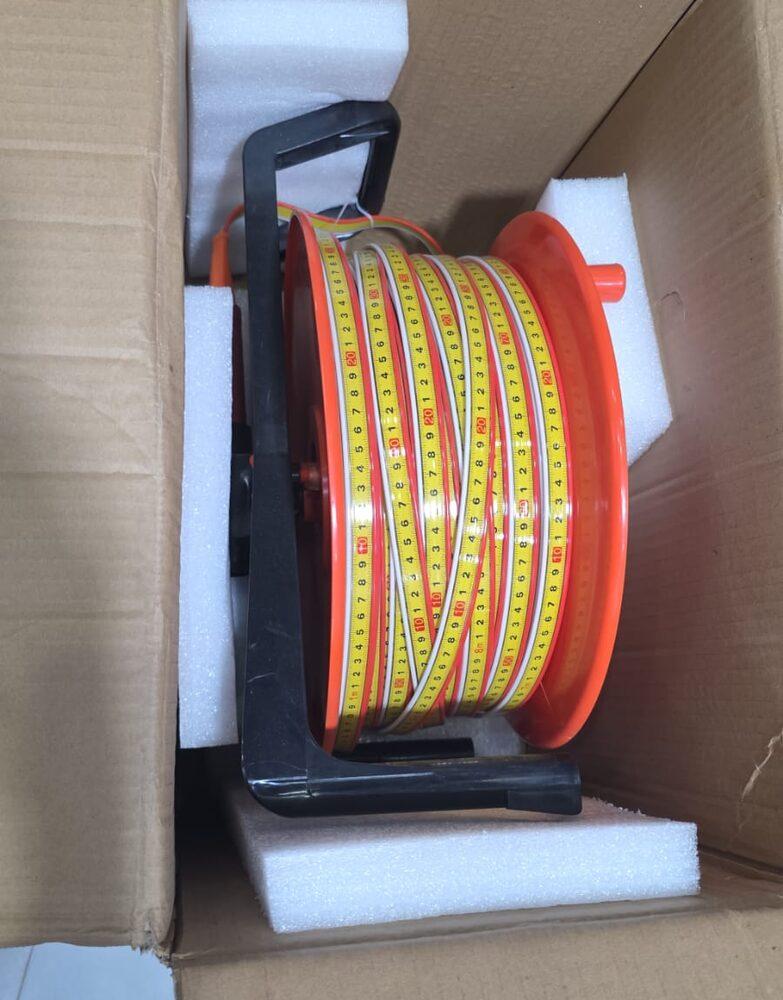
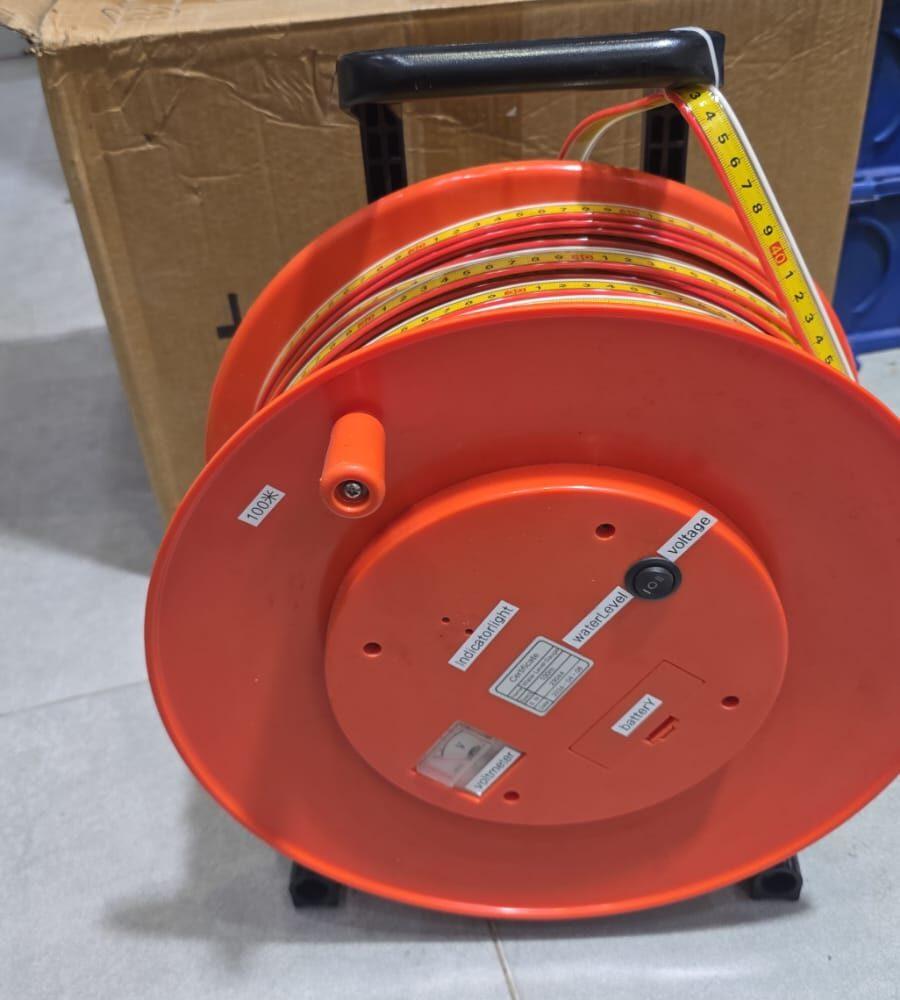
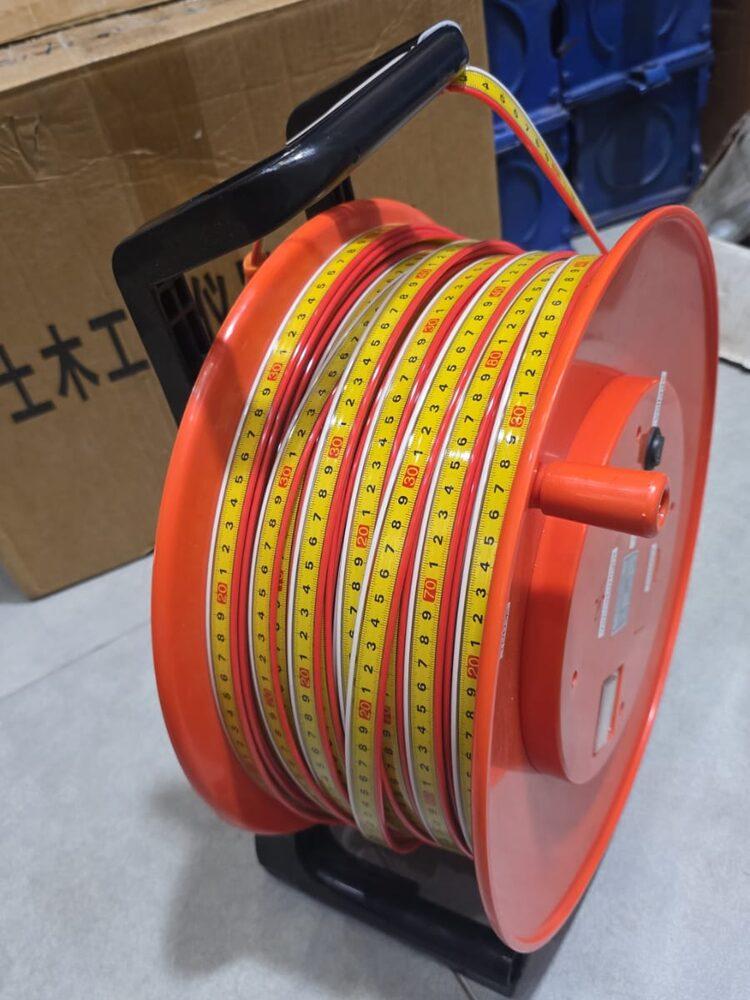
A water level meter has three parts: a reel carrying a graduated tape, a stainless probe at the end of the tape, and a small circuit with a battery, an indicator light and, on many models, a voltmeter or buzzer.
Two conductors run inside the tape. When the probe tip touches water, the water bridges the two electrodes and closes the circuit. The light comes on, the needle moves or the buzzer sounds, and the operator reads the tape at a fixed reference point on top of the casing. That reading is the depth to water.
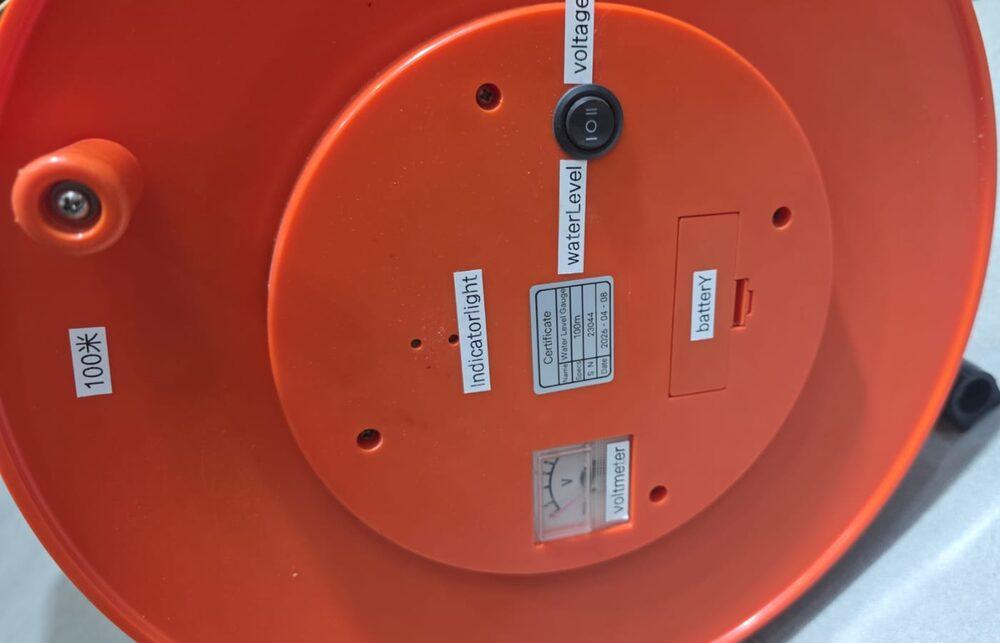
The water level meter we stock is this design: an orange reel on a stand with a carry handle, a yellow graduated tape, an indicator light, a voltmeter, a water level and voltage switch, and a battery compartment on the reel face. We hold it in 50 m and 100 m lengths, and each unit carries its calibration label.
Water level meter vs tank level indicator: which one do you need?
If the water is in a tank you own, you need a tank indicator. If the water is in the ground, you need a meter.
- Tank level indicator. Fixed sensors at set heights in an overhead or underground tank, wired to a display in the house. PKR 2,000 to 6,000. Answers "is the tank full?"
- Water level meter. Portable, lowered by hand into a well, borehole or standpipe. Answers "how many metres down is the water, and how far does it fall when the pump runs?"
Buyers sometimes ask whether a tank indicator can be adapted for a tube well. It cannot in any useful way. Its sensors sit at fixed points and its cable is a few metres long.
Which length to buy: the 1.5 times rule
The rule we give buyers is to buy a tape at least 1.5 times the deepest water level you will need to read, including drawdown with the pump running. The reason is practical: the static level is only half the job. During a pump test, or on a dewatering scheme, the level in the well falls, and a tape that only just reaches the rest level is useless once the pump starts.
By region, that usually means:
- Canal areas of Punjab and Sindh. Water often sits within 10 to 25 m. A 50 m meter covers both static and pumping levels.
- Rawalpindi, Islamabad, Chakwal, Attock. Many bores now have pumping levels beyond 50 m. Start at 100 m, and go deeper if you work in the newer sectors and societies on the edge of the twin cities.
- Quetta, Pishin, Mastung. Deep levels are ordinary. A 200 to 500 m meter is the realistic class.
If you are sizing for a specific bore, our guide on how to measure water level in a borewell walks through finding the depth before you buy.
What to check before you pay
Every meter that leaves our Rawalpindi store is checked in front of the buyer. These are the checks, and you should insist on them from anyone.
- Continuity test. Dip the probe in a bucket. The light should come on and the needle should move the moment the tip touches water, and go off the moment it leaves.
- Tape markings. Unreel the first 5 m and check the graduations are crisp and continuous. Printed markings that rub off with a thumb will be gone in a month.
- Probe to zero. The zero of the tape should be at the sensing point of the probe, not at the top of the probe body. On some cheaper meters it is out by 2 to 5 cm; if so, note the offset and add it to every reading.
- Battery compartment. It should close firmly. Dust and monsoon humidity kill contacts.
- Calibration label. It should show the length, serial number and date.
The field fault nobody warns you about
The most common "fault" brought back to us is not a fault. A meter that will not trigger in a well is usually reading very pure water, condensation running down the casing, or a film of oil on the surface. In a clean bore with low mineral content the circuit can be weak; the needle moves only slightly and the light is faint. Switch to the voltmeter and watch for the needle to jump rather than waiting for a bright light. The opposite problem is a false trigger from water dripping down the inside of the casing. If the meter triggers, lift 20 cm and lower again slowly. A real water surface triggers at the same mark every time; a drip does not.
How long does a water level meter last?
A reel meter used weekly lasts five years or more if the tape is looked after. Tapes fail at the top 10 m, where they are pulled over the casing edge most often. Run the tape over a smooth guide or your gloved hand rather than over raw steel, wipe it dry before reeling in, and store it out of direct sun. In Sindh and southern Punjab summers, a tape left on a vehicle dashboard can soften and stretch.
What we supply
- Water level meter, 50 m and 100 m: reel dipper with light, voltmeter and graduated tape, in stock in Rawalpindi.
- Borehole water level meter: 14 mm probe on a 150 m cable for slimmer bores and longer runs.
- Borehole inspection camera: to 200 m, for when the level reading raises questions about silting or casing.
- Submersible pumps for the pump test that follows.
The full range sits under detection and mining instruments. If you are siting a new bore rather than measuring an existing one, read our guide to underground water detector prices first, and for the pump that goes in afterwards see submersible pump price in Pakistan.
Ask for today's price
Send us the deepest water level you expect to read, whether you need it for a pump test, piezometers or routine checks, and your city. We will tell you which length fits and quote delivery. Send us a WhatsApp for today's price.
What we supply
Equipment covered in this guide
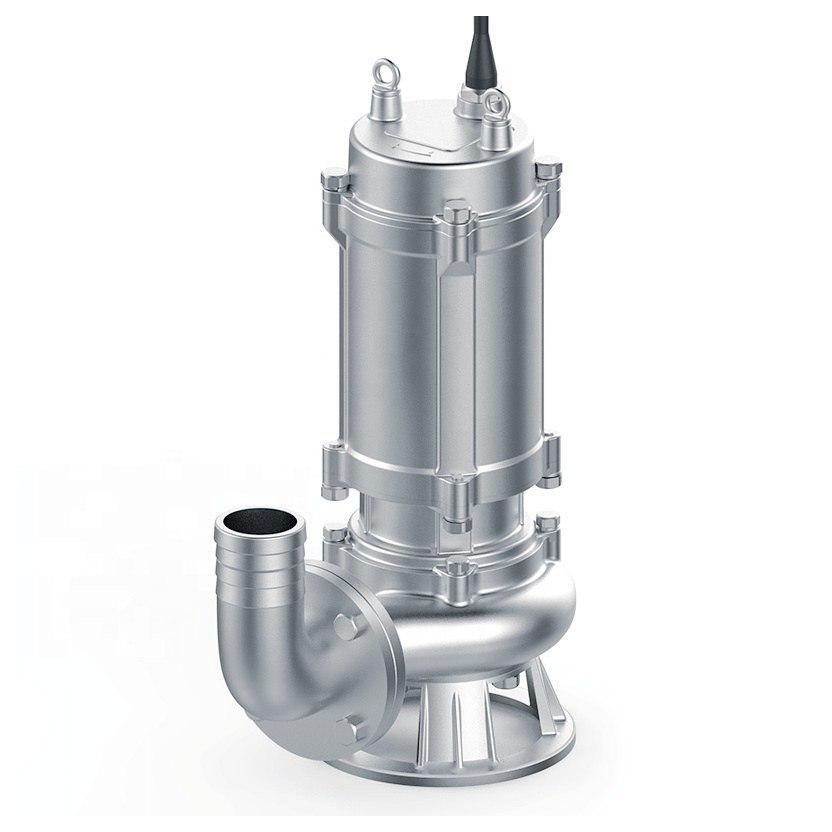
Submersible Pump
Electric submersibles for clean and dirty water, in the sizes a site actually keeps on the shelf.
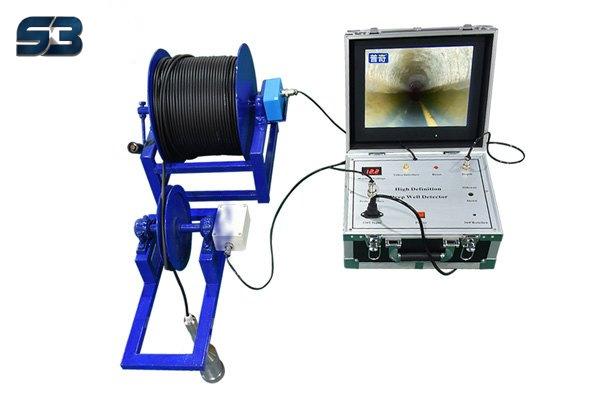 200 m borehole camera
Borehole Inspection Camera, 200 m
Two hundred metres of waterproof cable and a camera that looks sideways as well as down. Stops a borehole dispute becoming an argument.
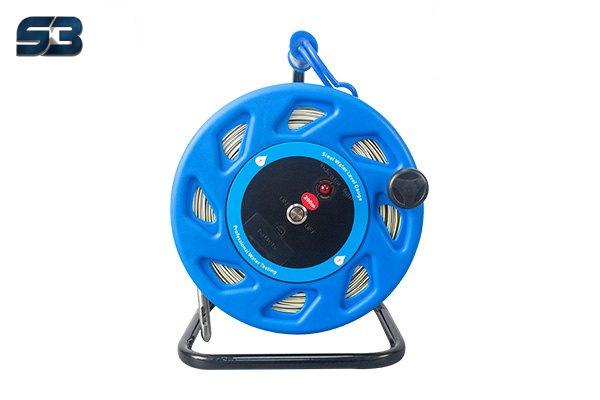 400 m water level indicator
Borehole Water Level Meter
Reeled probe on a marked cable, accurate to a tenth of a millimetre. The standard way to log a rest level and a drawdown.
FAQ
Questions buyers ask us
What is the price of a water level meter in Pakistan?
In October 2026 a 50 m reel water level meter sells for roughly PKR 30,000 to 55,000 and a 100 m unit for PKR 40,000 to 75,000. Deep meters of 200 to 500 m run PKR 70,000 to 200,000, and imported European brands cost several times that. These are indicative market ranges; confirm today's price on WhatsApp.
Is a water tank level indicator the same as a water level meter?
No. A tank indicator sits permanently in an overhead or underground tank and shows a few fixed levels, and costs PKR 2,000 to 6,000. A water level meter is a portable instrument with a graduated tape, often 50 or 100 m long, that you lower into a tube well, borehole or piezometer to read the depth to water.
Which length should I buy, 50 m or 100 m?
Buy a tape at least 1.5 times the deepest water level you expect to read, including drawdown while the pump runs. In canal areas of Punjab and Sindh a 50 m tape is usually enough. Around Rawalpindi and Islamabad, where pumping levels often pass 50 m, start at 100 m.
How accurate is a tape water level meter?
A graduated tape reads to the nearest centimetre, and a careful operator repeats a reading within about 1 cm. The bigger errors come from the method: not using a fixed reference point on the casing, reading while the probe is still swinging, or measuring a pumping well before the level has settled.
What battery does a water level meter use?
Most reel meters run on a small dry battery in a compartment on the reel face, commonly a 9 V cell or a pair of AA cells depending on the model. Carry a spare: a flat battery gives no light and no needle movement, which an operator can mistake for a dry well.
Do you deliver water level meters outside Rawalpindi?
Yes. We dispatch across Pakistan by courier, usually in 2 to 4 working days, and each unit is shown working with its calibration label before it leaves our Rawalpindi store. Send the depth you need to read and your city on WhatsApp for a quote.