Pressure washer price in Pakistan in 2026 runs from about PKR 13,000 for a 105 bar domestic electric unit to PKR 120,000 to 450,000 for a petrol site machine and PKR 900,000 and above for a hot water industrial washer. The gap is flow and duty: how much water the pump moves and for how many hours a day.
Most of the pressure washers sold in Pakistan are built to wash a car on a Sunday. Contractors buy them for plant, formwork and yards, run them all day in 44 degree heat, and wonder why the pump is finished in three months. This guide sets out the price bands, the one number that actually decides cleaning speed, and what we see fail on the bench in Rawalpindi.
How much does a pressure washer cost in Pakistan?
A domestic electric washer costs PKR 13,000 to 30,000, a heavy domestic or light commercial unit PKR 30,000 to 120,000, a petrol site washer PKR 120,000 to 450,000, and a hot water industrial machine PKR 900,000 to 2,500,000. These are indicative market ranges for new machines in October 2026. Confirm today's price on WhatsApp, rates move with the exchange rate.
| Class | Pressure | Flow | Power | Typical brands | Indicative market price (PKR) |
|---|---|---|---|---|---|
| Entry domestic | 100 to 130 bar | 5 to 7 L/min | 1.4 to 1.8 kW, 220 V | Hyundai, Ingco, Total, Dera | 13,000 to 30,000 |
| Heavy domestic | 140 to 180 bar | 7 to 9 L/min | 2.0 to 2.8 kW induction | Karcher K series, Bosch, Total | 30,000 to 120,000 |
| Commercial cold, electric | 150 to 200 bar | 10 to 15 L/min | 3 to 7 kW, often 3 phase | Karcher HD, Chinese triplex | 200,000 to 600,000 |
| Petrol site washer | 150 to 250 bar | 10 to 15 L/min | 6.5 to 13 hp petrol | Karcher pump on Honda GX, value units | 120,000 to 450,000 |
| Hot water industrial | 150 to 200 bar | 12 to 18 L/min | Petrol or electric, with burner | Landa, Karcher HDS | 900,000 to 2,500,000 |
The step from PKR 25,000 to PKR 250,000 looks like a lot of money for the same job. It is not the same job. A domestic washer has a universal motor and an aluminium wobble plate pump rated for about 20 to 30 minutes of use at a time. A commercial machine has a crankshaft triplex pump with ceramic pistons, an engine or induction motor rated for continuous duty, and seals that are replaced, not thrown away with the pump.
Bar or litres per minute: which one cleans faster?
Litres per minute decides cleaning speed. Pressure breaks the dirt loose, but water is what carries it away, and a jet with twice the flow clears roughly twice the area in the same time.
A useful way to compare machines is to multiply the two:
- Entry domestic: 130 bar x 7 L/min = 910 cleaning units.
- Petrol site washer: 200 bar x 15 L/min = 3,000 cleaning units.
That is more than three times the work per hour, which is why a crew with an industrial machine washes down a concrete mixer drum before the slurry sets, and a crew with a domestic washer is still at it when it has. Sellers advertise bar because it is the bigger number. Ask for flow first, and be wary of any listing that does not give it.
More pressure than about 200 bar does not help on construction work. It cuts into timber formwork, strips paint you wanted to keep and etches fresh concrete. Flow is safe to have in excess. Pressure is not.
Domestic vs industrial: which one do you need?
If the machine will run more than an hour a day, buy industrial. That single rule covers most decisions.
Domestic suits a home, a car, a bike, a porch, solar panels on one roof. It plugs into a household socket, weighs 10 to 15 kg and is cheap to replace.
Industrial suits a car wash, a transport yard, a batching plant, formwork, façades, poultry sheds and factory floors. It is heavy, it is meant to be repaired, and the cost per hour of use over five years is lower than replacing a domestic unit every season.
Solar panel cleaning is the one domestic job where buyers overbuy. Panels need low pressure and clean water, not 180 bar, which can damage the seals around the glass.
Hot water or cold water?
Choose hot water only when the dirt is oil, grease or diesel. At 60 to 80 degrees, grease melts off a hydraulic ram or a workshop floor. Cold water at any pressure just moves it around and spreads it thinner.
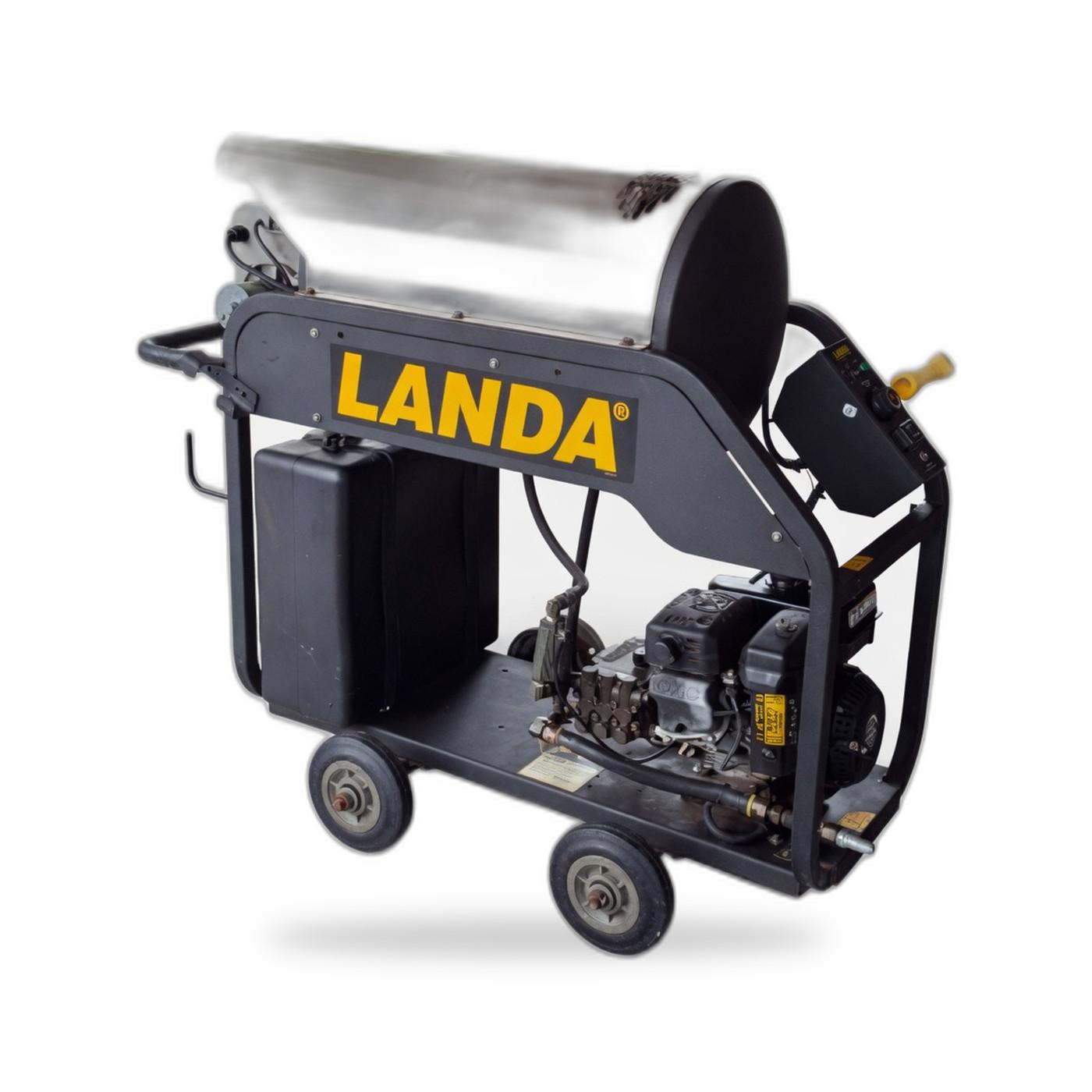
The Landa hot water pressure washer has a fired coil that heats the water on its way to the gun, a petrol engine so it runs without three phase power, and a four wheel trolley frame. It is the machine for plant hydraulics, formwork with release agent on it and wash bays.
For mud, dust, cement slurry and general site cleaning, cold water does the job at about a third of the price.
Petrol, electric and load-shedding
A petrol washer is the right buy wherever power is unreliable or absent: a new road, a society under development, a quarry or a plant yard. It does not care about load-shedding, and it does not stall when the voltage drops to 180 volts on a summer afternoon, which is exactly when an electric induction motor overheats and trips.
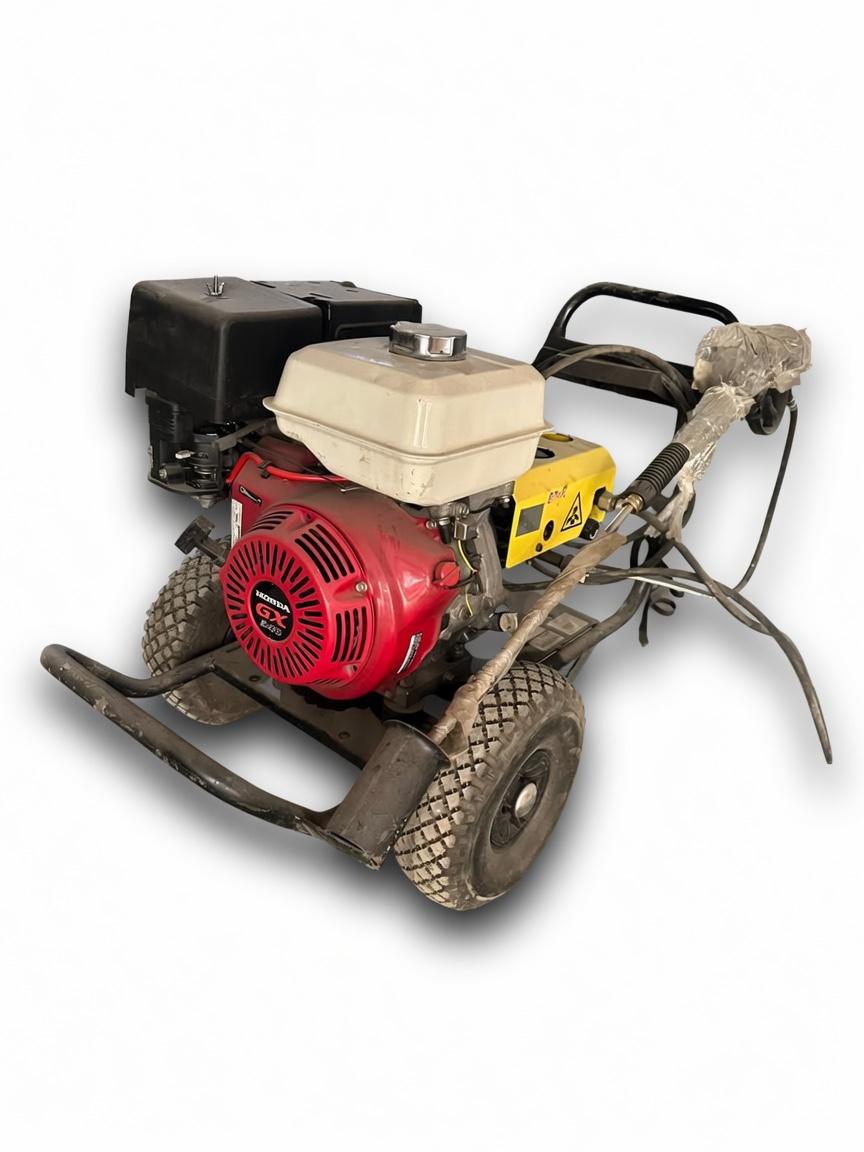
The Karcher high pressure washer pairs a Karcher pump with a Honda GX petrol engine on a trolley frame with pneumatic wheels. The pump gives the pressure, the Honda gives the reliability, and the frame survives being thrown on the back of a truck.
Electric machines make sense in a fixed wash bay with a stable three phase supply. They are quieter, need no fuel, and can be plumbed in.
Hard water: what kills pumps in Rawalpindi and Karachi
Hard water is the most common cause of a pressure washer losing pressure in Pakistan. Bore water in Rawalpindi, Islamabad's sectors on tubewell supply, Lahore and much of Karachi carries enough calcium to leave white scale inside the unloader valve, the nozzle and, on hot water machines, the heating coil.
On a cold machine, scale makes the unloader stick, so pressure surges or drops. On a hot water machine, scale insulates the coil, the burner works harder for the same temperature, and eventually the coil blocks. A descaling flush every few months and a simple inlet filter cost far less than a new coil.
The bucket test: one check nobody does
Before you buy a used machine, and every month on your own, time how long the gun takes to fill a 10 litre bucket with the nozzle removed. A 15 L/min machine should do it in about 40 seconds. If it takes a minute, either the pump seals are worn or the inlet is starving.
Inlet starvation is the failure we see most often on the bench. The pump needs more water arriving than it pushes out, so a 15 L/min washer wants 18 to 20 L/min at the inlet. A long half inch pipe from a roof tank often delivers under 10. The pump cavitates, the seals and valves wear in weeks, and the buyer blames the brand. Feed it from a drum at ground level with a three quarter inch hose, or put a small submersible pump in the drum.
What we supply
Our washers and pumps are under pressure pumps and washers.
- Karcher high pressure washer: Karcher pump on a Honda GX engine, trolley mounted, for plant, formwork, façades and yards with no power.
- Landa hot water pressure washer: petrol driven with a fired coil, for oil, grease and cured slurry.
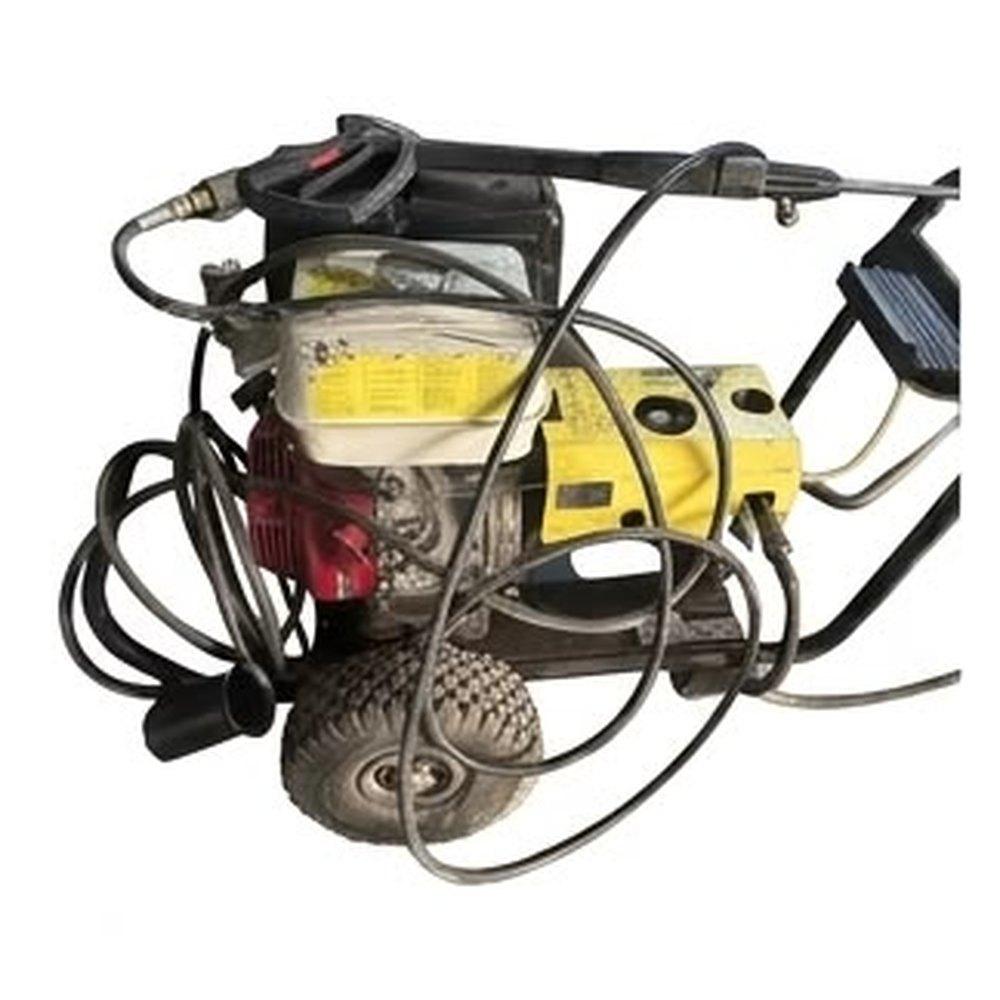
- Petrol pressure washer: a site washer with gun, lance and hose reel for vehicle and formwork cleaning.
- Dewatering pump and submersible pump: for excavations, basements, monsoon work and feeding a washer from a drum.
Lances, hoses and nozzles are held in Rawalpindi and machines are serviced on our own bench. If you are pricing a plant to wash down, read concrete batching plant price in Pakistan. For indoor floors, a pressure washer is the wrong tool: see floor cleaning machine price in Pakistan for scrubber dryers and sweepers.
Ask for today's price
Prices above are market ranges and they move with the exchange rate. Tell us what you are cleaning, how many hours a day the machine will run, and whether you have three phase power, and we will recommend the right class honestly. Send us a WhatsApp for today's price on a Karcher, Landa or petrol site washer, with delivery across Pakistan.
What we supply
Equipment covered in this guide
KarcherPetrol, Honda GXKarcher High Pressure Washer
Karcher pump on a Honda GX engine, trolley mounted with pneumatic wheels. For plant, formwork, façades and yards with no power supply.
 Landa
LandaLanda Hot Water Pressure Washer
Petrol driven, with a fired coil that puts hot water through the lance. Heat is what shifts oil, grease and cured slurry that cold water only moves around.
Petrol Pressure Washer
Site pressure washer with a petrol engine, gun, lance and hose reel. Good for vehicle and formwork cleaning.
FAQ
Questions buyers ask us
What is the price of a pressure washer in Pakistan?
In 2026 a domestic electric washer of 105 to 130 bar sells for about PKR 13,000 to 30,000, a heavier 140 to 180 bar home unit for PKR 30,000 to 120,000, a petrol site washer for PKR 120,000 to 450,000 and a hot water industrial machine for PKR 900,000 and above. These are indicative market ranges.
Which matters more, bar or litres per minute?
For cleaning speed, litres per minute. Pressure breaks the dirt loose, flow carries it away. A 130 bar washer at 7 litres a minute and a 200 bar machine at 15 litres a minute differ by roughly three times in useful cleaning work, which is why the industrial unit clears a mixer drum in a fraction of the time.
Is a Karcher pressure washer worth the price?
For daily commercial work, yes. The pump is the part that wears, and a Karcher pump with ceramic pistons and serviceable seals runs for years where a sealed domestic pump is thrown away after one or two seasons. For washing one car a week, a PKR 20,000 to 30,000 domestic unit is the sensible buy.
Do I need a hot water pressure washer?
Only if you are cleaning oil, grease or diesel. Hot water at 60 to 80 degrees releases grease that cold water only smears around, so workshops, plant yards and wash bays benefit. For mud, dust, slurry and façades, a cold water machine is enough and costs roughly a third as much.
Can I run a pressure washer from a roof tank?
Only if the supply keeps up. The pump needs more water at the inlet than it delivers, so a 15 litre a minute machine needs at least 18 to 20 litres a minute arriving. A long half inch line from a roof tank often gives less than 10, and the pump cavitates and wears out its seals in weeks.
Why is my pressure washer losing pressure?
In order of likelihood: a worn nozzle, a blocked inlet filter, hard water scale in the unloader valve, or worn pump seals. A nozzle costs PKR 1,000 to 3,000 and should be the first thing replaced. If a 10 litre bucket takes much longer to fill than it used to, the pump seals are going.