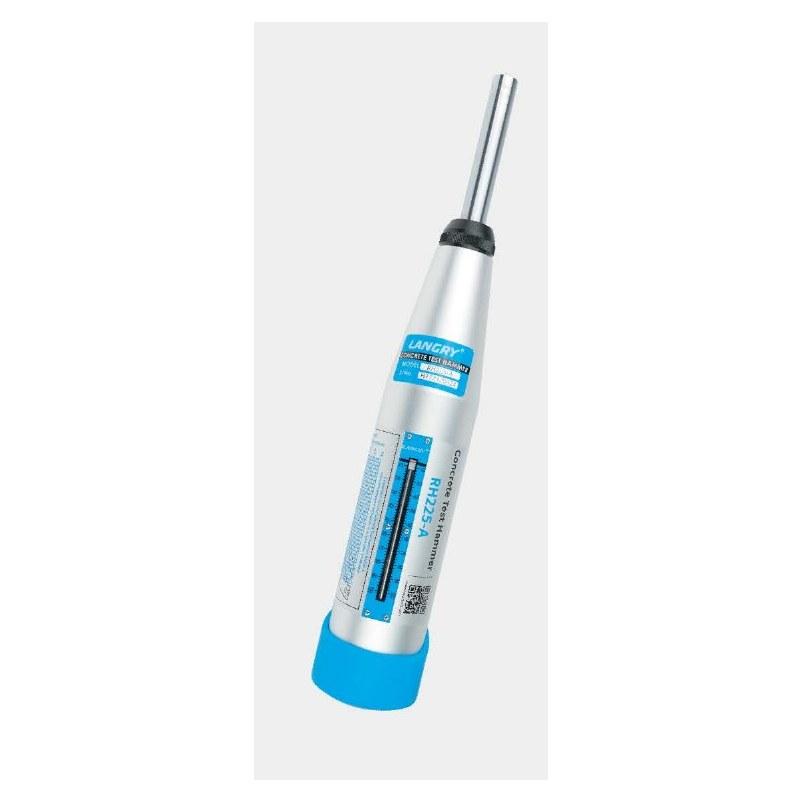
Rebound hammer testing estimates the compressive strength of in-place concrete from its surface hardness: a spring-loaded mass strikes the surface and the rebound distance, read as a number from 10 to 100, is converted to strength through a correlation curve. An analogue Schmidt-type hammer costs about PKR 25,000 to 45,000 in Pakistan in 2026, a digital one PKR 90,000 to 180,000.
The rebound hammer is the most used and most misused instrument in Pakistani concrete testing. It is quick, cheap and non-destructive, which is why consultants carry one to every site, and it gives a number that looks like a strength, which is why that number gets argued over. This guide explains what the test actually measures, how to do it properly, which hammer to buy and how to keep it honest with an anvil.
What the test measures and its limits
A rebound hammer, often called a Schmidt hammer after the original Swiss design, contains a mass on a spring. Pressing the plunger against the concrete releases the mass, which strikes the plunger and rebounds. The rebound distance, as a percentage of the forward travel, is the rebound number R. Harder surfaces give higher R.
Surface hardness correlates with compressive strength for a given concrete, so R can be converted to an estimated strength. That correlation depends on:
- Aggregate type and size. Limestone and gravel aggregates give different curves.
- Cement content and type. More cement, higher R for the same strength.
- Moisture. Wet surfaces read lower by up to 20 percent.
- Carbonation. Old concrete develops a hard carbonated skin that reads high while the interior is weaker. This is the biggest source of error on structures over ten years old.
- Surface finish. Trowelled surfaces read higher than formed surfaces.
- Age. Curing affects the surface differently from the interior.
The hammer tests the outer 30 mm. It says nothing about honeycombing behind the surface, cover to reinforcement, or the strength of the core. Used to compare areas of the same structure, or to flag suspect areas for coring, it is excellent. Used alone to certify a strength, it is not defensible, and a good consultant will not sign a report on rebound numbers without correlation.
Rebound hammer test procedure
The procedure in ASTM C805 and IS 13311 Part 2, shortened to what the technician does on site:
- Check the hammer on the anvil. An N-type hammer should read 80 plus or minus 2 on the Langry GZ series testing anvil. Record the reading.
- Select the test area. At least 150 by 150 mm, on a formed surface where possible, away from edges, joints and visible reinforcement. Use a rebar scanner to confirm there is no bar within 30 mm.
- Prepare the surface. Grind off laitance, paint and loose material with the carborundum stone supplied. The surface should be smooth and dry.
- Take ten readings. Hold the hammer perpendicular to the surface, press steadily until it fires, read R. Space the impacts at least 25 mm apart. Never strike the same point twice.
- Discard outliers. Discard any reading more than 6 units from the mean, and if more than two are discarded, discard the whole set and test a new area.
- Record orientation. Horizontal, vertically up, vertically down or at 45 degrees. The correlation curve corrects for gravity on the mass.
- Convert to strength using the correlation curve for this concrete, or at minimum the manufacturer's curve with a stated caveat.
- Report location, orientation, the ten readings, the mean R, the estimated strength, the hammer serial number and the anvil reading.
A trained technician takes about five minutes per test area. The digital hammers do steps 4 to 7 automatically.
Analogue vs digital
Indicative market prices in Pakistan in September 2026. Confirm today's price on WhatsApp, rates move with the exchange rate.
| Model | Type | Impact energy | Reading | Memory and output | Indicative market price (PKR) | Best for |
|---|---|---|---|---|---|---|
| Langry RH225-A | Analogue N-type | 2.207 Nm | Pointer on scale | None, paper record | 25,000 to 45,000 | Site checks, contractors, teaching |
| Langry RH75-A | Analogue L-type | 0.735 Nm | Pointer on scale | None | 30,000 to 55,000 | Thin sections, precast, mortar |
| Langry RH225-B | Digital N-type | 2.207 Nm | LCD, automatic R | Stores thousands of readings, USB to PC, angle correction, curve selection | 90,000 to 180,000 | Consultants, labs, reports |
| Original Swiss N-type | Analogue N-type | 2.207 Nm | Pointer on scale | None | 180,000 to 300,000 | Firms specifying the original brand |
| Original Swiss digital | Digital N-type | 2.207 Nm | LCD | Logging, PC software | 450,000 and up | Large consultancies |
The analogue RH225-A does everything the standard requires and is the hammer in most Pakistani site bags. The digital RH225-B removes reading error, applies the angle correction automatically, stores the data against a location and prints a report from the PC. For a consultant producing a report that a client will argue over, the digital hammer pays for itself the first time the data is questioned.
Calibration with the anvil
The spring in a rebound hammer weakens, the guide rod wears and the mass picks up dirt. All of these drop the reading, and a hammer reading low will tell you sound concrete is weak.
The test anvil is a hardened steel cylinder of known hardness, mounted so the hammer strikes it squarely. A correctly calibrated N-type hammer reads 80 plus or minus 2 on the anvil. Check before every job and record the reading on the report. If the hammer drifts outside the range, it needs cleaning and possibly a new spring, which we do on our bench in Rawalpindi.
Every hammer we sell is checked on the anvil before dispatch and leaves with the reading recorded. For consultancy work, we recommend buying the anvil with the hammer; a report that quotes the anvil reading is a report that stands up.
Reading the number: correlation curves
The manufacturer's curve printed on the hammer or built into the digital unit is a general curve for average concrete. It is a starting point. For a defensible strength estimate on a specific structure, build a correlation:
- Take rebound readings at six to ten locations.
- Core those locations and test the cores in a compression machine, or if the concrete is new, test cubes from the same pour.
- Plot core strength against mean R and fit a curve.
- Use that curve for the rest of the structure.
For the same concrete, this brings accuracy to within 15 to 20 percent. Without it, treat the estimate as plus or minus 25 percent and say so in the report.
Orientation correction matters too. A hammer fired vertically downwards reads higher than one fired horizontally because gravity helps the mass. The curves correct for this. The digital hammer asks for the angle; on the analogue hammer the technician applies the correction from the chart.
Other NDT instruments
The rebound hammer is one tool in the non-destructive kit. The others we supply from the Langry range:
- Rebar scanner. The Langry RS350 integrated rebar scanner locates reinforcement, measures cover and estimates bar diameter. Essential before rebound testing, coring or drilling, and for cover checks on new work.
- Ultrasonic pulse velocity. The UPV tester sends a pulse through the concrete and measures transit time. It detects voids, cracks and honeycombing through the full section, which the hammer cannot. Combined with rebound numbers in the SonReb method, it gives a better strength estimate than either alone.
- Pile integrity tester. A low-strain impact on the pile head and an accelerometer reveal necks, bulges and breaks along the pile. Standard on foundation acceptance.
- Crack width and depth gauge, pull-off tester, anchor pull-out tester for specific checks.
A consultant's site bag usually holds the hammer, the anvil and the rebar scanner. The lab holds the UPV and the pile tester.
Who buys them in Pakistan
Consulting engineers. Structural assessment of existing buildings, strength verification on new work, dispute resolution between contractor and client. The digital hammer with anvil and a rebar scanner is their standard set.
Government and semi-government engineering bodies. Project supervision and quality audits on roads, bridges, buildings and irrigation structures. We supply against tenders and framework agreements.
Universities and colleges. Civil engineering departments teaching NDT, usually analogue hammers in sets with one digital and one anvil.
Ready mix and precast quality teams. Checking early strength before demoulding or striking formwork.
Contractors. An analogue hammer to know when a slab can be loaded, and to have a number of their own when the consultant arrives.
What we supply
The Langry range is under Langry products, with the rest of the testing equipment under civil lab equipment.
- Langry RH225-A concrete rebound hammer: the analogue N-type standard.
- Langry RH225-B digital concrete test hammer: logging, angle correction, PC reports.
- Langry RH75-A concrete test hammer: L-type for thin sections.
- Langry GZ series rebound hammer testing anvil: the calibration reference.
- Langry RS350 integrated rebar scanner: find the steel before you test.
If the concrete you are testing comes from your own plant, our guide to concrete batching plant price in Pakistan covers calibration of the weigh systems that determine what strength you get in the first place.
Ask for today's price
Prices above are the market and move with the exchange rate. Tell us whether the hammer is for site checks, consultancy reports or a teaching lab and we will quote the right model, with the anvil if the work needs it. Send us a WhatsApp for today's price and delivery across Pakistan in two to three days.
What we supply
Equipment covered in this guide
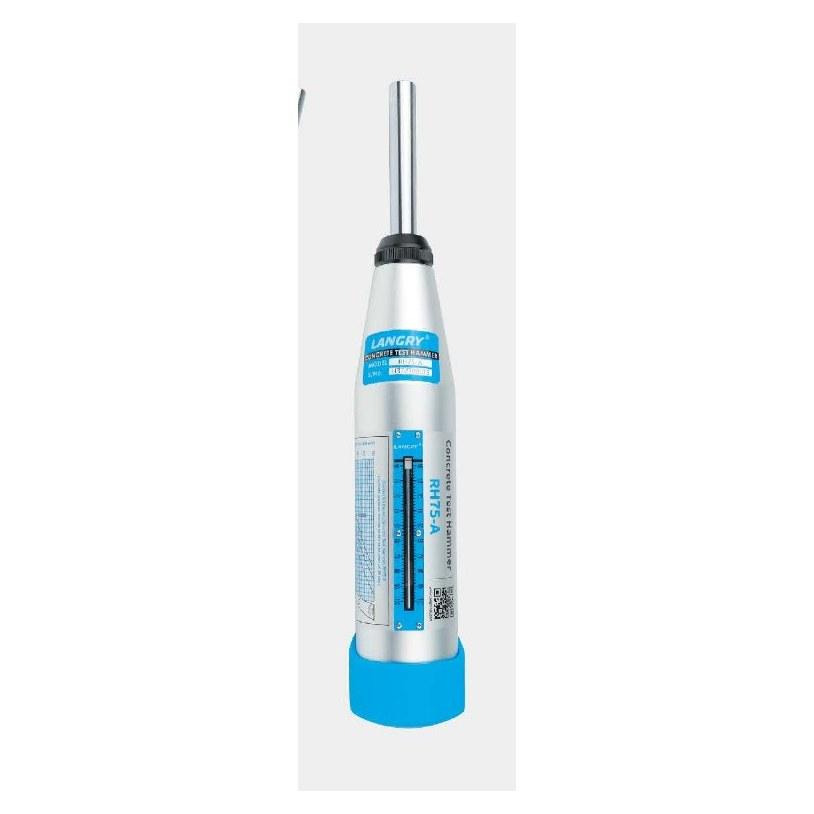 LangryRH75-A
Langry RH75-A Concrete Test Hammer
The light rebound hammer, 0.735 joules, for thin sections, precast units and anywhere the full 2.207 joule impact would be too much.
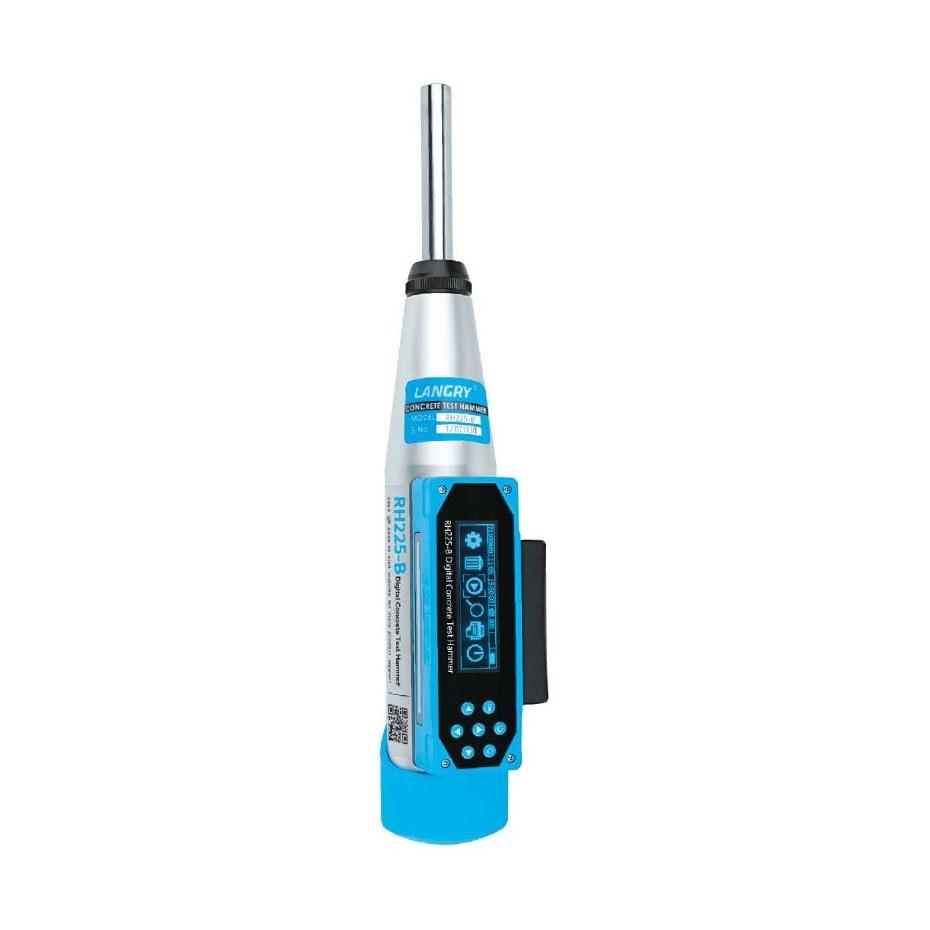 LangryRH225-B
Langry RH225-B Digital Concrete Test Hammer
The digital hammer. Electromagnetic sensor, a gyroscope that knows which way you are pointing it, and a thousand test areas in memory.
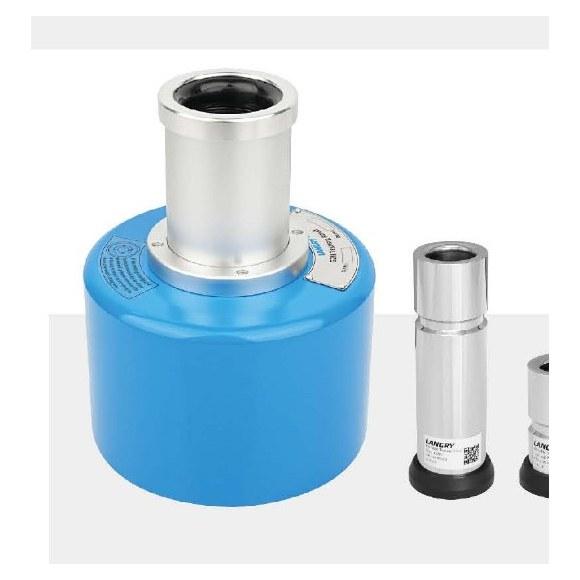 LangryGZI / GZII / GZIII / GZIV
Langry GZ Series Rebound Hammer Testing Anvil
The anvil every rebound hammer is calibrated against. Four weights, one for each hammer in the range.
FAQ
Questions buyers ask us
What is the price of a rebound hammer in Pakistan?
In 2026 an analogue N-type rebound hammer such as the Langry RH225-A sells for around PKR 25,000 to 45,000 in the Pakistani market, and a digital hammer with data logging such as the Langry RH225-B for PKR 90,000 to 180,000. A calibration anvil adds PKR 25,000 to 60,000. These are market ranges; we quote by WhatsApp.
What does a rebound hammer test measure?
It measures the surface hardness of concrete by firing a spring-loaded mass against the surface and recording how far it rebounds. The rebound number correlates with compressive strength, but it is an estimate of the outer 30 mm, not a replacement for cube or core tests.
Is the rebound hammer test accurate?
With a hammer calibrated on an anvil, a properly prepared surface and a correlation curve built from cores or cubes of the same concrete, accuracy is within about 15 to 20 percent. Using the manufacturer's generic curve without correlation, expect 25 percent or worse. It is a screening tool, not a strength test.
What is the difference between an N-type and an L-type hammer?
N-type hammers have 2.207 Nm impact energy and are for normal structural concrete over 100 mm thick. L-type hammers have 0.735 Nm and are for thin sections, precast units and sensitive surfaces. Langry RH225 models are N-type and RH75 models are L-type.
How often should a rebound hammer be calibrated?
Check on the anvil before every job and at least every 2,000 impacts. The anvil should return a reading of 80 plus or minus 2 for an N-type hammer. If it reads outside that, the hammer needs service. A full calibration with a certificate is recommended annually for consultancy work.
Who uses rebound hammers in Pakistan?
Consulting engineers checking existing structures, government and semi-government engineering bodies, university and college civil labs, ready mix plant quality teams, and contractors wanting an early indication of strength before striking formwork. We supply all of them across Pakistan.