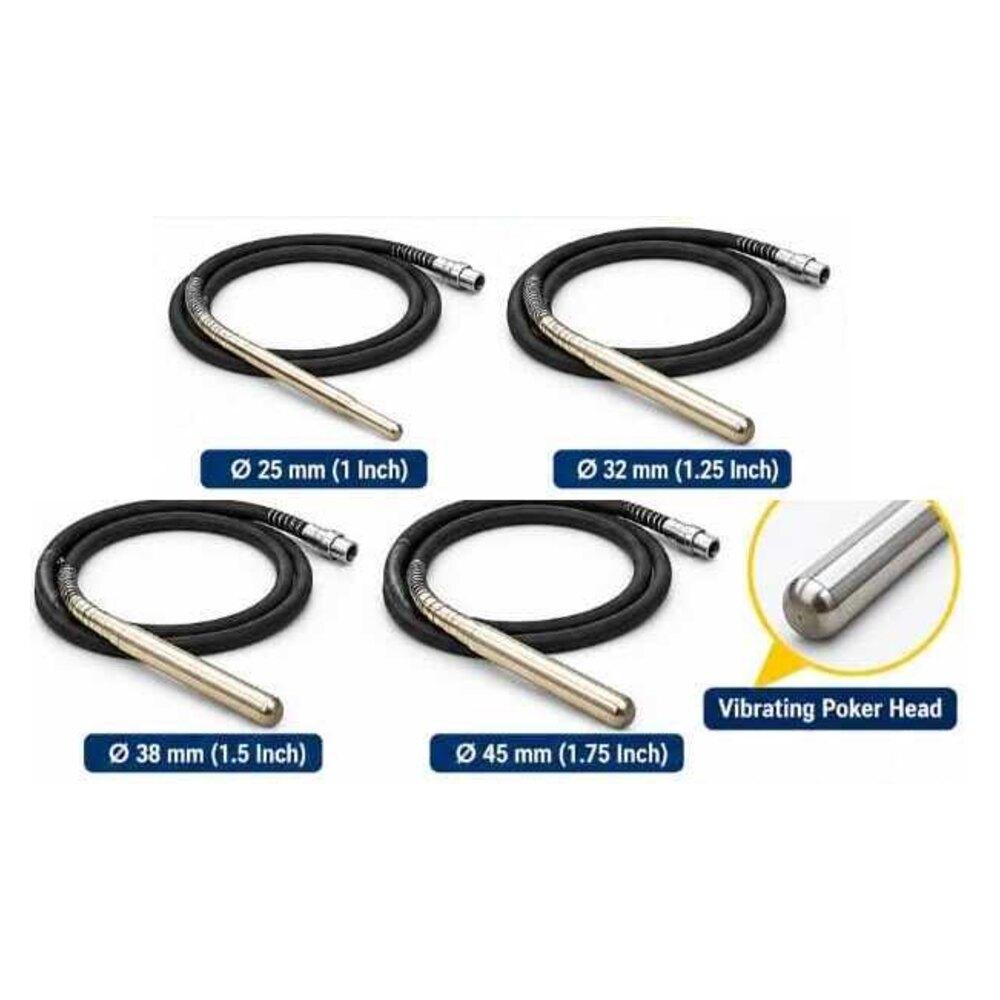
Vibrator needle size runs from 25 mm to 60 mm in diameter, and on Pakistani building sites four sizes do almost all the work: 25, 32, 38 and 45 mm. Pick the largest head that fits between the bars. Its radius of action is roughly 8 to 10 times its diameter, which sets how far apart you insert it.
Most honeycombing we are shown is not caused by a bad machine. It is caused by the wrong head for the member, insertions too far apart, or a needle whipped in and out in two seconds. This guide sets out which head goes where, and how to use it so the consultant has nothing to chip out.
What vibrator needle size do you need?
| Head diameter | Radius of action (workable mix) | Insertion spacing | Best for |
|---|---|---|---|
| 25 mm | 100 to 150 mm | 150 to 225 mm | Thin walls, congested beam-column joints, precast, lintels |
| 32 mm | 150 to 250 mm | 225 to 350 mm | Columns 230 to 300 mm, beams, retaining walls up to 200 mm |
| 38 mm | 200 to 300 mm | 300 to 450 mm | Slabs, beams, larger columns, general building work |
| 45 mm | 250 to 350 mm | 375 to 500 mm | Thick slabs, rafts, footings, retaining walls over 300 mm |
| 50 to 60 mm | 300 to 450 mm | 450 to 650 mm | Mass concrete, dams, bridge piers, large rafts |
Radius of action is approximate and shrinks in stiff, low-slump concrete. Figures follow common practice in ACI 309R and the specifications NESPAK and other Pakistani consultants write around it.
The working rule: use the biggest needle that passes through the reinforcement with at least 25 mm to spare on each side. A bigger head compacts more concrete per insertion, but if it jams in the cage the operator will give up and leave that corner unvibrated.
Which needle for walls, columns, slabs and rafts?
Columns
A typical residential column in Rawalpindi or Lahore is 230 x 300 mm or 300 x 300 mm with ties at 150 mm. A 32 mm head fits between the ties and reaches the corners. Lower it from the top in one pass to the bottom of each lift, and pour columns in lifts of about 500 mm, not in one go. Pouring a 3 metre column in one shot and vibrating only the top is the single most common reason for honeycomb at the foot.
Walls
Retaining walls and water tanks of 200 to 250 mm thickness take a 32 or 38 mm head. Insert at 300 to 400 mm spacing along the wall, in layers of about 400 mm. In water tanks, pay extra attention at the kicker joint: a poorly compacted kicker is where tanks leak in the first monsoon.
Slabs and beams
A 125 to 150 mm house slab with beams takes a 38 mm head. Insert vertically where depth allows. In thin slabs, insert at an angle of about 45 degrees so the full length of the head is in the concrete. Vibrate the beams first, then the slab.
Rafts and footings
Rafts of 450 mm and more take a 45 mm head, or two machines working side by side. Pour in layers of 300 to 500 mm, and push the needle about 150 mm into the layer below so the two knit together. On a large raft in Islamabad or Bahria Town, plan one vibrator for every 8 to 10 cubic metres per hour of placing rate, plus one standby.
How far apart should you insert the needle?
Space insertions at about 1.5 times the radius of action so the compacted circles overlap. Work in a grid, not a single line down the middle of the pour.
A quick field check: watch the surface around the needle. The circle where paste appears and bubbles rise is the real radius of action for that mix, on that day. If the circles do not touch from one insertion to the next, move closer. Workers often space insertions by the length of their stride, which is about 700 mm, and that is too far for anything smaller than a 50 mm head.
How long should you hold the vibrator in concrete?
About 5 to 15 seconds per insertion in normal workable concrete. Signs that compaction is complete:
- Large air bubbles stop breaking at the surface
- A thin, glossy film of paste appears around the needle
- The concrete surface around the needle levels off and stops sinking
- The sound of the needle settles to a steady pitch
Withdraw slowly, at about 75 mm per second, so the hole closes behind the head. Pulling out fast leaves a void that you will see as a vertical streak when the shuttering comes off.
Over-vibration
Over-vibration happens, but under-vibration is ten times more common on Pakistani sites. Holding a needle for 30 seconds or longer in a wet, high-slump mix lets coarse aggregate sink and paste and water rise, leaving a weak top layer. Signs are a thick layer of water and fines at the surface and visible segregation. The cure is fewer seconds per point, not fewer points.
Revibration
Concrete that has started to stiffen can sometimes be vibrated a second time, which closes settlement cracks over the top bars and improves the bond. The test is simple: if the needle still sinks into the concrete under its own weight and the hole closes when you pull it out, revibration helps. If the needle leaves an open hole, the concrete has gone too far and should be left alone.
Never use the needle to move concrete sideways along a form. It separates paste from stone, and you get a honeycomb where the stone ends up.
Mistakes that cause honeycombing
- Needle touching the shuttering. It leaves sand streaks on the finished face. Keep 75 to 100 mm away from the form.
- Needle held against the bars. It shakes the cage and can loosen ties. A brief touch is fine; holding it there is not.
- Running the head in air. The needle relies on concrete to cool its bearings. In summer heat, a minute in air cooks the grease.
- No standby machine. A single machine that breaks halfway through a pour leaves half a slab uncompacted. Keep a spare shaft at least.
- Pouring too fast. If placing outruns the vibrator, the layers are too deep for the needle to reach. Match the pour rate to the number of machines.
Lab vibrators are a different thing
Cube and cylinder moulds in the laboratory are compacted either by tamping rod or on a vibrating table, not by a site poker. If you are compacting test specimens, the procedure follows ASTM C31 for cylinders made in the field and BS EN 12390-2 for making and curing specimens. A laboratory vibrator gives repeatable compaction for those, which a site needle cannot. See concrete cube test and concrete cylinder mould.
What we supply
We stock shafts in several lengths with interchangeable needle heads, and the drives that run them:
- Concrete vibrator shaft and poker needle in 25 to 45 mm heads
- Concrete poker vibrator
- Honda GX160 concrete vibrator engine
- Robin EY20 concrete vibrator engine
- ENAR concrete vibrator engine
- Browse all small construction machinery
For costs, read concrete vibrator price in Pakistan. To choose a drive, see Honda GX160 vs Robin EY20.
Ask for today's price
Send us the member sizes, bar spacing and the size of your largest pour, and we will tell you which needle heads and how many machines you need. Shaft and needle prices are 2026 market ranges; confirm today's price on WhatsApp, rates move with the exchange rate. Contact us on WhatsApp.
What we supply
Equipment covered in this guide
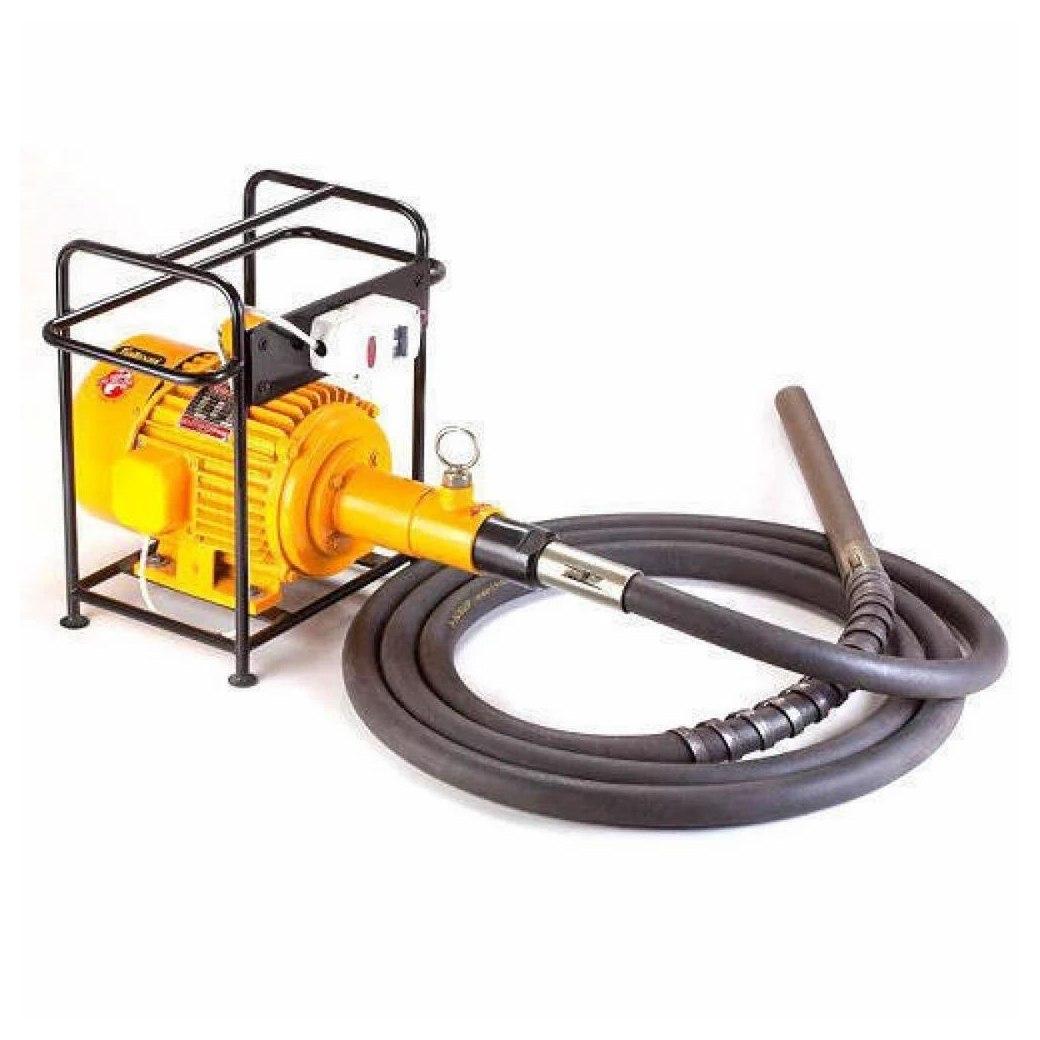
Concrete Poker Vibrator
Petrol drive unit with a flexible shaft and poker head, in the usual diameters. Spare shafts and heads held.
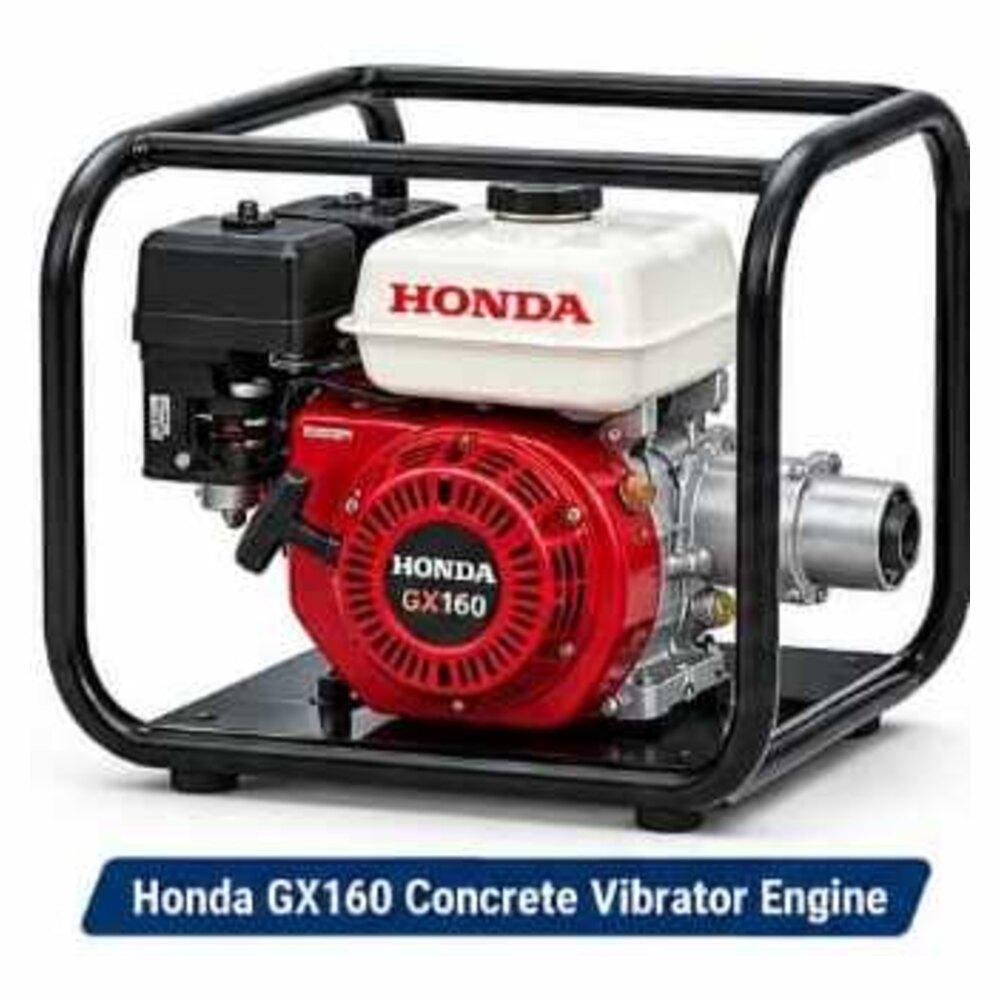 GX160
Honda GX160 Concrete Vibrator Engine
The vibrator drive most contractors ask for by name: a Honda GX160 petrol engine in a roll cage, with a quick coupling for any standard poker shaft.
 EY20
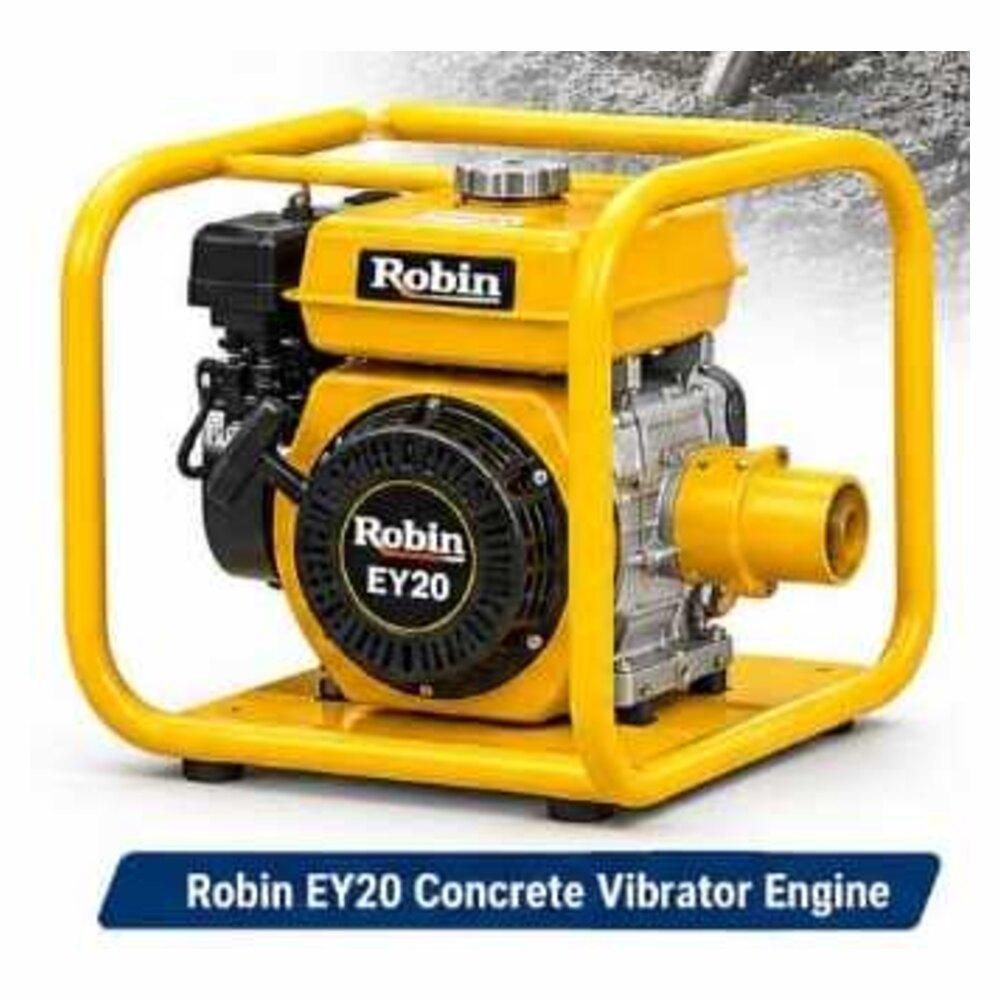
Robin EY20 Concrete Vibrator Engine
Robin EY20 petrol drive in a yellow roll cage. A long serving vibrator engine with a reputation for running in heat and dust.
FAQ
Questions buyers ask us
Which vibrator needle size is used for columns?
For a typical 230 to 300 mm column with congested bars, a 32 or 38 mm needle is right. It fits between the ties and reaches the corners. Larger columns, 450 mm and up, with wider bar spacing can take a 45 mm head.
What is the radius of action of a needle vibrator?
Roughly 8 to 10 times the head diameter in normal workable concrete. A 25 mm needle compacts about 100 to 150 mm around itself, a 38 mm needle about 200 to 300 mm, and a 45 mm needle about 250 to 350 mm. Stiff mixes shrink the radius.
How far apart should vibrator insertions be?
Space insertions at about 1.5 times the radius of action so the compacted circles overlap. For a 38 mm needle that is roughly 350 to 450 mm apart, in a grid, not in a single line. Closer is safer than wider.
Is there a code for vibrating concrete?
Yes. ACI 309R is the widely used guide to consolidation of concrete, and most Pakistani specifications written by NESPAK and other consultants follow its practice. It covers head size, radius of action, insertion spacing, layer depth of about 300 to 500 mm, and withdrawal speed.
Can you over-vibrate concrete?
Yes, though under-vibration is far more common. Holding a needle 30 seconds or more in a wet mix lets the coarse aggregate sink and water and paste rise, leaving a weak, dusty top 20 to 50 mm. Stop when the surface shows a paste film.
How long should a vibrator stay in concrete?
About 5 to 15 seconds at each insertion in normal workable concrete with a slump of 75 to 125 mm. Stiffer mixes need longer. Withdraw slowly, about 75 mm per second, so the hole closes. Large bubbles stopping is your signal.