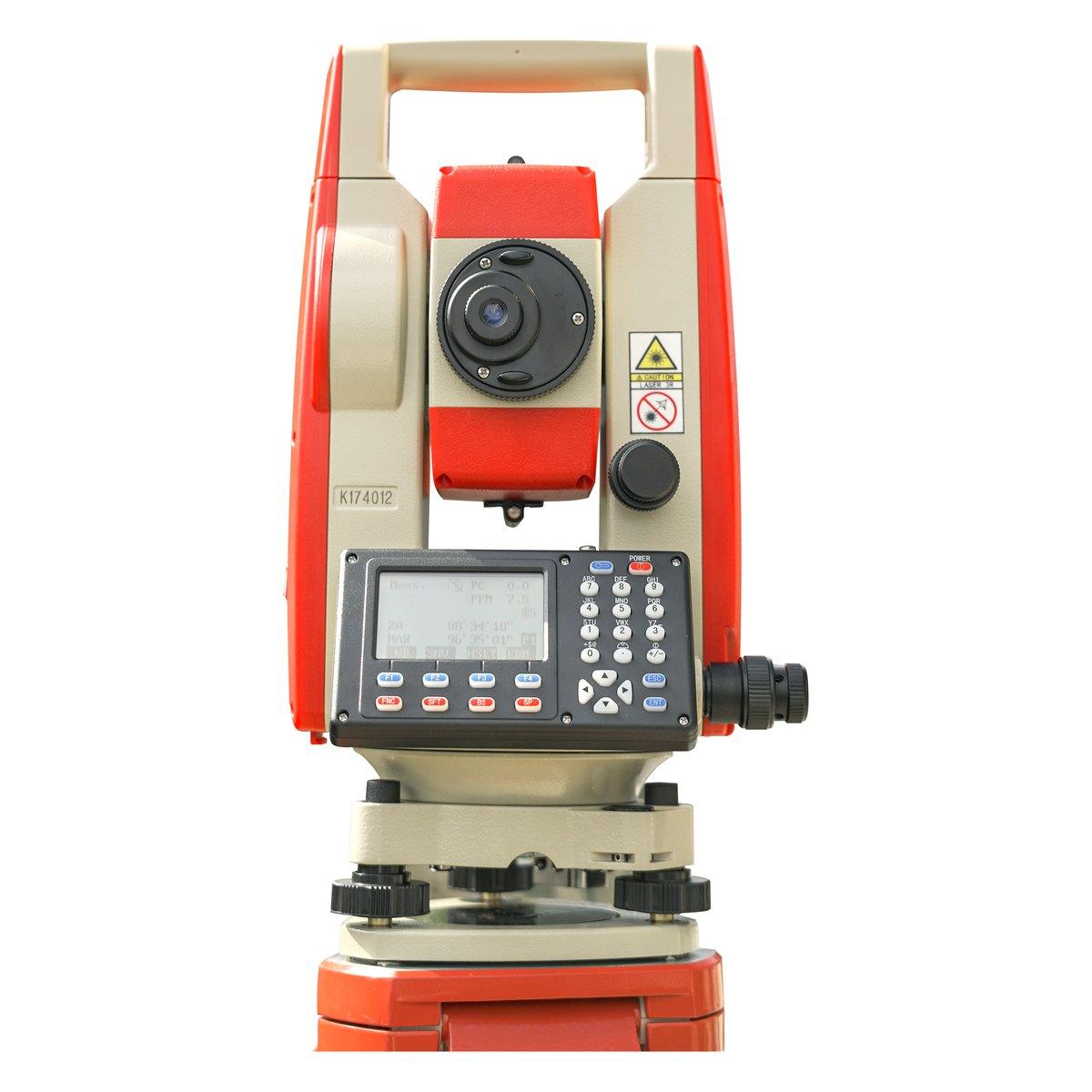
The best total station for surveying in Pakistan is a 2 second reflectorless instrument with local spares and a bench that can calibrate it: for most contractors and survey firms that is the Kolida KTS-442P, and for consultancies and audited government work it is the Sokkia iM series. Robotic instruments are worth it only for one-person topographic crews.
We have been asked this question across the counter in Faizabad for more than twenty years, and the answer has changed less than the brochures suggest. What has changed is that reflectorless EDMs, dual-axis compensators and onboard storage are now standard on even the cheapest new instrument, so the real decision comes down to who is holding it, what the output goes into, and who fixes it when it falls off a tripod.
What makes a total station good for Pakistani site conditions
Three things damage total stations here: dust, heat and sun.
Dust gets into the horizontal and vertical drives and the battery contacts. An instrument rated IP54 or better, with sealed tangent screws, survives a Punjab summer on a housing society site. An older unrated instrument does not. All current Kolida and Sokkia models are IP54 or IP65.
Heat matters for the EDM and the display. Between May and August, an instrument left on a tripod at noon reaches 55 degrees Celsius on the housing. Specification on most instruments stops at 50. The practical rule is to keep the instrument in the case under shade between setups and never leave it on the tripod through lunch. Lithium batteries also lose capacity above 45 degrees, so a crew in Multan or Sukkur should carry three rather than two.
Sun affects the operator more than the instrument. A high contrast display, a reticle that can be illuminated, and a laser pointer for reflectorless aiming all make a difference in afternoon glare. The Sokkia iM has the better screen. The Kolida KTS-591 Android has a bright colour touchscreen that is readable in sun, which the older keypad models are not.
Accuracy classes explained
Angle accuracy is quoted in arc seconds, and the two classes that matter in Pakistan are 2 second and 5 second.
At 100 metres, a 2 second instrument puts a point to about 1 mm and a 5 second instrument to about 2.4 mm. At 1 kilometre those become roughly 10 mm and 24 mm. For building setting out, where sightlines are rarely more than 150 metres, either is better than the carpenters you hand the marks to. For a control traverse along 5 kilometres of road, 2 seconds is worth the extra PKR 40,000 to 80,000 because the error does not accumulate as fast.
Distance accuracy is quoted as a fixed part plus a part per million, typically 2 mm plus 2 ppm with a prism. Every instrument in the table below meets that. Reflectorless accuracy is usually 3 mm plus 2 ppm on a good surface and worse on dark or wet concrete.
The compensator is the part that quietly earns its money. A dual-axis compensator corrects for the instrument being slightly out of level in both directions. Single-axis compensators are still found on very cheap instruments and on some older used units, and they are the reason a cheap instrument reads differently in the morning and the afternoon.
Reflectorless range
Every current instrument we sell is reflectorless. The question is how far.
A 400 metre reflectorless range is standard and sufficient for buildings, plots and roads. A 600 to 1,000 metre range costs more and matters for quarry faces, river crossings, transmission towers and tall facades where nobody can put a prism. Range is quoted on a white Kodak grey card in good light; on dark rough concrete in afternoon haze expect about half.
If you regularly measure beyond 500 metres without a prism, specify it. If you do not, pay for a second battery instead.
Kolida vs Sokkia
This is the comparison most Pakistani buyers are actually making. Indicative market prices for a complete set in September 2026; only the Kolida KTS-442P figure is our confirmed price.
| Kolida KTS-442P | Sokkia iM-52 | |
|---|---|---|
| Angle accuracy | 2" | 2" |
| Reflectorless range | 600 m | 500 m (800 m on iM-55 class) |
| Compensator | Dual axis | Dual axis |
| Display | Dual LCD keypad | Dual graphic LCD, better in sun |
| Onboard memory | 20,000 points plus USB | 50,000 points plus USB |
| Battery life | About 8 hours | About 20 hours |
| Weather rating | IP54 | IP65 |
| Warranty from us | 2 years | 2 years |
| Spares in Rawalpindi | Full | Full |
| Resale after 5 years | Around 35 percent | Around 55 percent |
| Indicative price, complete set | PKR 500,000 (our price) | PKR 950,000 to 1,125,000 (market) |
The honest reading of that table: the Sokkia is a better instrument. Battery life alone changes the way a crew works. But the Kolida does the same job on 90 percent of Pakistani sites at half the cost, and if it goes over a parapet, replacing it hurts far less. We sell many more Kolidas than Sokkias, and the Sokkia buyers are mostly consultancies, universities and firms with a client who audits their equipment list.
Confirm today's price on WhatsApp, rates move with the exchange rate.
Android total stations
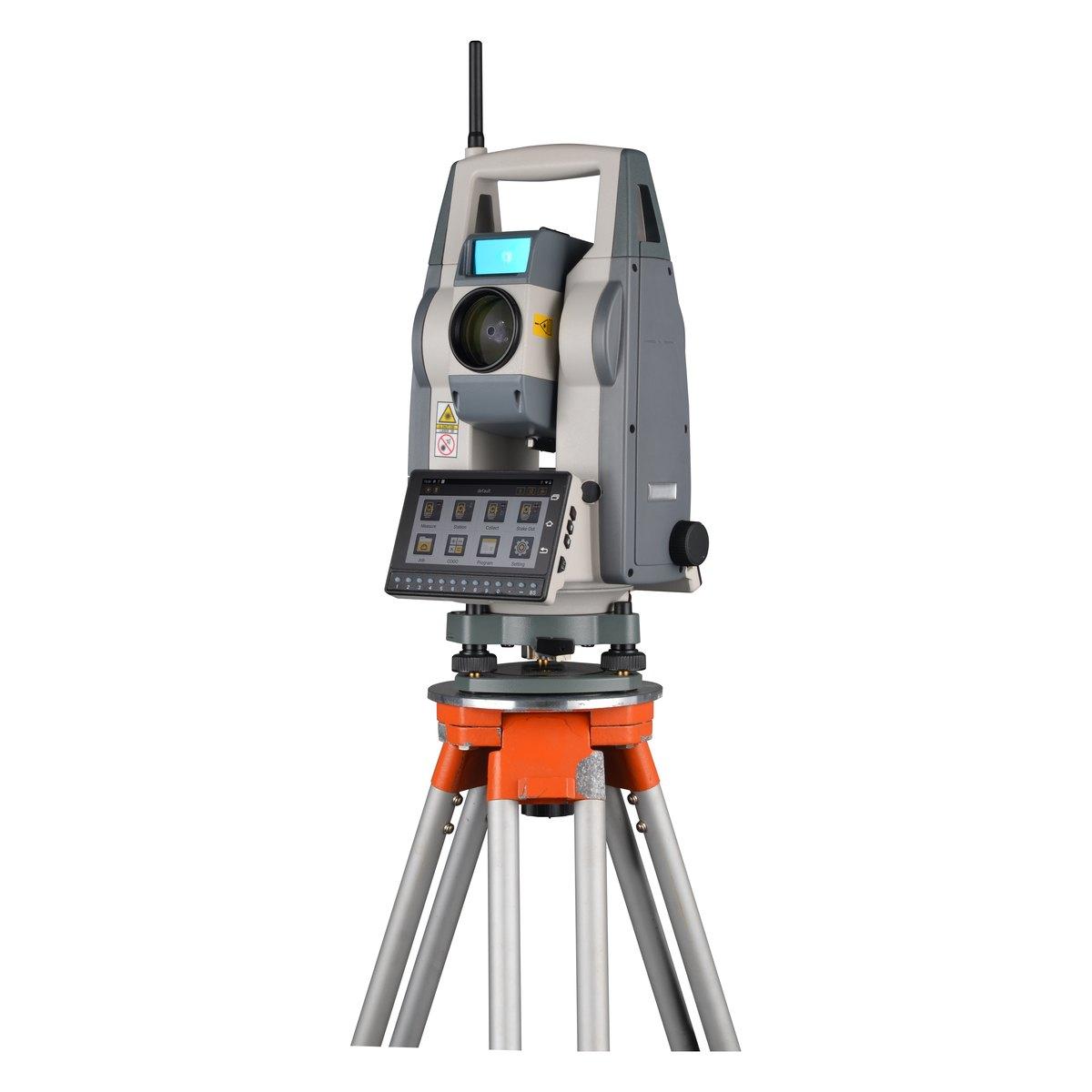
The newer class of instrument runs Android on a colour touchscreen with onboard CAD. The Kolida KTS-591 Android is the one we supply.
What it changes in practice:
- You can load a DXF design file and stake out directly from the drawing, picking points on screen.
- Data exports over WiFi or to a phone, so the draughtsman has the day's work before the crew is back.
- The screen is readable in sun and the interface is familiar to a younger operator within an hour.
What it costs: PKR 150,000 to 300,000 more than the keypad version, plus a shorter battery life because of the screen. For a firm that does layout from CAD every day it pays for itself. For a crew doing levelling runs and chainage, it is money better spent on a second instrument.
Robotic: when it is worth it
A robotic total station tracks the prism automatically, so one person at the pole runs the whole survey. Topcon GT, Sokkia iX and Leica TS16 are the names, and the market price in Pakistan starts around PKR 4,500,000 with a controller.
The arithmetic: a two-man crew costs roughly PKR 120,000 to 180,000 a month in wages, transport and food. If robotic removes one man from a crew that works 22 days a month on topographic jobs, the instrument repays its premium over a manual Sokkia in about three to four years. That works for a survey consultancy with steady work. It does not work for a contractor who sets out one building a quarter and otherwise keeps the instrument in a cupboard.
Robotic instruments also need a prism with a 360 degree reflector, a controller with a radio link, and an operator who understands the tracking. We can supply all three, and we are honest with buyers about when they do not need them.
Spares and service in Pakistan
An instrument is only as good as the bench that can fix it. We stock for Kolida and Sokkia: batteries, chargers, prisms, tribrachs, data cables, keypads, tangent screws and the common boards. Calibration of collimation, compensator and EDM is done in Rawalpindi, usually within three working days. For Leica and Topcon we can supply consumables but anything electronic goes back to the importer and takes weeks.
This is the strongest practical argument for Kolida and Sokkia for any firm outside Lahore, Karachi and Islamabad. An instrument that is away for two months is not an instrument.
Our recommendation by job type
Housing society developer or building contractor. Kolida KTS-442P, 2 second, complete set at PKR 500,000. Everything the layout needs, spares on the shelf, survivable if damaged.
Highway, canal or railway contractor. Kolida KTS-442P for the setting-out crews, one Sokkia iM series for the control work and for anything that goes to the consultant with a stamp.
Building contractor with a CAD office. Kolida KTS-591 Android, so the crew stakes from the drawing and the office gets the data the same afternoon.
Survey consultancy. Sokkia iM for the manual crews, and a robotic instrument once the workload justifies one-man topographic crews.
University or training institute. Kolida KTS-442P, because students drop instruments and the budget has to stretch to tripods, prisms and an auto level as well.
What we supply
Everything above is under total stations, calibrated before dispatch and covered by a two year warranty on our own bench.
- Kolida KTS-442P: the standard Pakistani site instrument.
- Kolida KTS-591 Android: touchscreen, onboard CAD.
- Sokkia iM series: authorised Sokkia supply with full spares.
For a breakdown of what each one costs with a complete set, see our total station price in Pakistan guide. If your work is mostly levels and grades rather than angles, an auto level or a laser level may be all you need, and we cover both on this blog.
Ask for today's price
Market prices change with the exchange rate, so the numbers here are a guide, not a quote. Tell us what the instrument will be used for and we will recommend one honestly, including a cheaper one if that is the right answer. Send us a WhatsApp for today's price, stock and delivery to your site.
What we supply
Equipment covered in this guide
KolidaKTS-442PKolida KTS-442P Total Station
The workhorse of our survey counter. Reflectorless measurement, a rugged field build and a hard carry case that survives the back of a pickup.
 KolidaKTS-591
Kolida KTS-591 Android Total Station
A total station with an Android touch screen on the front and a keypad underneath it. Everything the 442P does, with survey software running on the instrument instead of a separate controller.
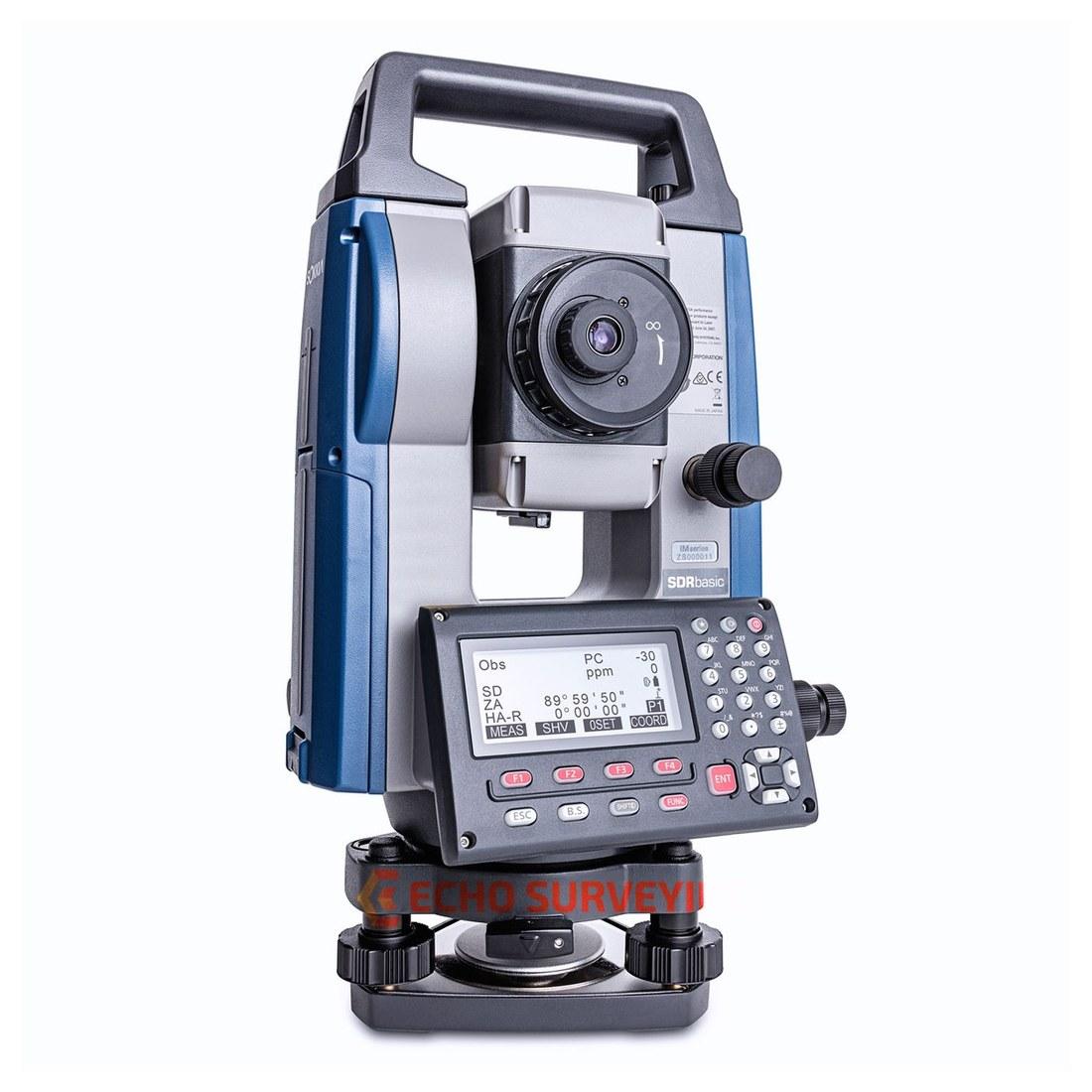 SokkiaiM-50 / iM-52 / iM-55 / iM-60 / iM-100 series
Sokkia iM Series Total Station
Japanese optics and angle measurement for control work where the tolerance is not negotiable. The iM-50, iM-55 and iM-100 series, supplied with training and calibration.
FAQ
Questions buyers ask us
Which total station is best for construction in Pakistan?
For building layout, housing societies and road work, a 2 second reflectorless Kolida such as the KTS-442P is the best balance of accuracy, price and local spares. It handles dust and heat well, and a replacement is affordable if it is damaged on site.
Is Kolida or Sokkia better?
Sokkia has better optics, a more durable EDM and higher resale value. Kolida costs about half as much and does the same job on most sites. Choose Sokkia for consultancy and government work that will be audited; choose Kolida for contracting and general surveying.
What does 2 second accuracy mean on a total station?
It is the standard deviation of a single angle measurement in arc seconds. A 2 second instrument gives about 1 cm of position error at 1 km; a 5 second instrument gives about 2.4 cm. For most building and road work either is adequate. Use 2 seconds for long control traverses.
Do I need a reflectorless total station?
Yes for almost every site. Reflectorless measurement lets you shoot to walls, columns, slabs and slopes without sending a man with a prism. All current Kolida and Sokkia models are reflectorless to at least 400 metres, so it is no longer an upgrade you have to pay for.
Is an Android total station worth the extra cost?
It is if the crew exports data to AutoCAD every day or works from DXF design files. Onboard CAD, WiFi transfer and a touchscreen save an hour of office time per day. If the crew still writes readings in a book, a keypad instrument is the better buy.
Are spares for total stations available in Pakistan?
For Kolida and Sokkia, yes. We hold batteries, chargers, prisms, tribrachs, cables and common boards in Rawalpindi and service on our own bench. For Leica and Topcon, consumables are available but boards and EDM modules usually take weeks to import.