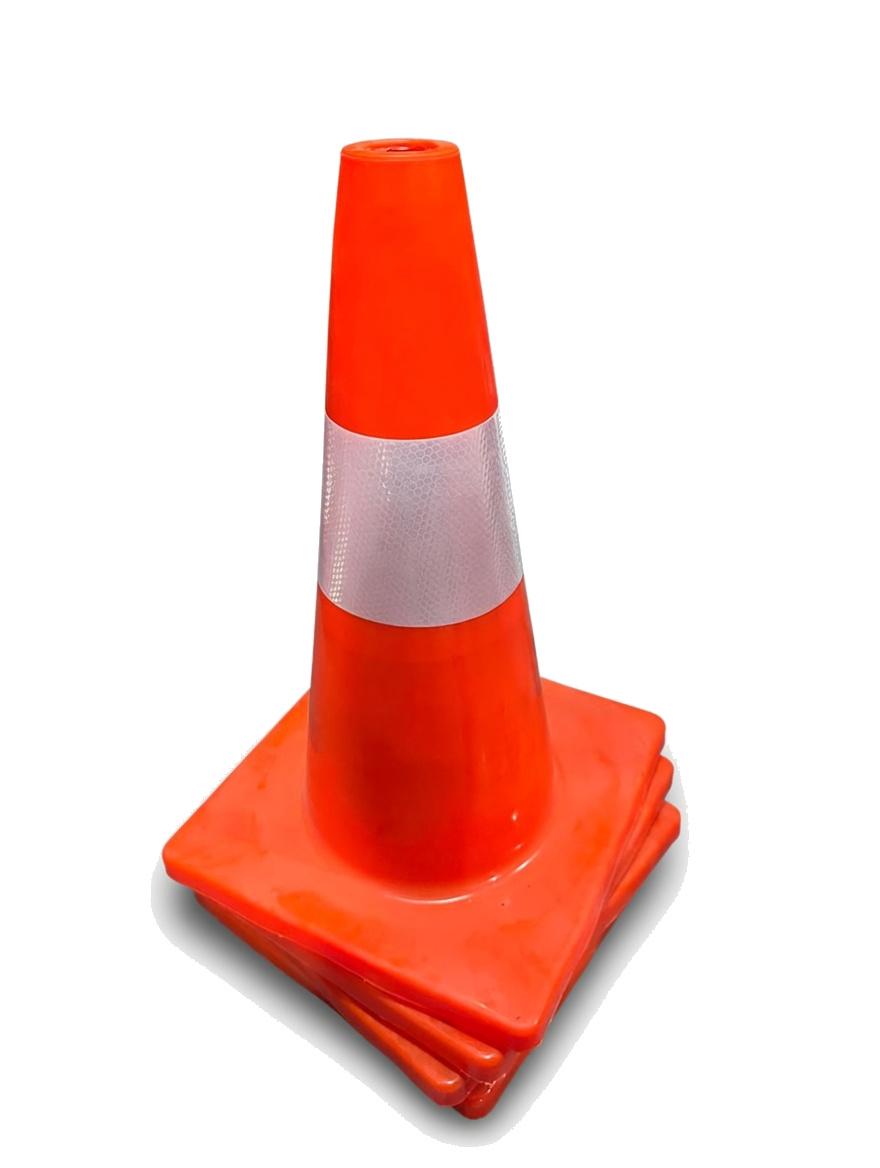
Traffic cone price in Pakistan in 2026 is about PKR 600 to 1,200 for a 450 mm PVC cone, PKR 1,400 to 2,800 for a 750 mm reflective cone, PKR 2,200 to 4,000 for a 750 mm cone on a rubber base and PKR 3,500 to 6,500 for 1000 mm. Size and base weight should follow road speed.
Traffic cones are bought by road contractors on NHA and provincial highway packages, by CDA and municipal contractors, by housing societies, parking operators, factories and event companies. Most cones are bought by count and price. The ones that stay standing on a motorway are bought by weight. This guide covers sizes, materials, reflective collars, the Pakistani sun and how to estimate how many you need.
How much does a traffic cone cost in Pakistan?
| Height | Body | Base | Reflective collars | Typical weight | Indicative market price (PKR per cone) |
|---|---|---|---|---|---|
| 300 mm (12 inch) | PVC or PE | Integral | 1 or none | 0.5 to 1 kg | 350 to 700 |
| 450 mm (18 inch) | PVC | Integral | 1 | 1 to 1.5 kg | 600 to 1,200 |
| 700 to 750 mm (28 to 30 inch) | PVC | Integral | 2 | 1.8 to 2.5 kg | 1,400 to 2,800 |
| 700 to 750 mm | PVC | Rubber base | 2 | 3 to 4.5 kg | 2,200 to 4,000 |
| 1000 mm (39 to 40 inch) | PVC | Rubber base | 2 or 3 | 4.5 to 7 kg | 3,500 to 6,500 |
| Collapsible or LED | Fabric or ABS | Weighted | LED or tape | 1 to 2 kg | 1,600 to 3,500 |
These are 2026 market ranges per cone. Bulk lots of 50 or 100 come in under single cone prices. Confirm today's price on WhatsApp, rates move with the exchange rate.
Which size of safety cone should you buy?
Choose by the speed of the traffic passing the cone, not by budget.
- 300 and 450 mm: car parks, factory floors, petrol stations, school gates, warehouse aisles, wet floor areas alongside a wet floor caution sign. Speeds under about 30 km/h.
- 750 mm: the general road cone. City roads, GT Road, housing society main boulevards, utility trenches, CDA and municipal works.
- 1000 mm: motorways, national highways and anywhere traffic passes at high speed or at night. Taller cones are seen sooner over the bonnet of the car in front.
When in doubt on a public road, go up a size. A driver at 100 km/h covers about 28 metres a second; every extra metre of warning counts.
PVC, PE and rubber base: what is the difference?
PVC is the standard material for good cones. It flexes when hit and springs back, and holds its colour better when UV stabilised.
PE (polyethylene) cones are cheaper and lighter. They crack in cold weather and split when a wheel runs over them. They are fine indoors.
Rubber base cones have a PVC body seated on a heavy recycled rubber base. The weight sits low, which is what keeps a cone standing.
On a motorway, a cone under about 3 kg does not stay where you put it. The slipstream from a passing truck lifts and rolls it into the live lane, where it becomes a hazard of its own. On NHA and motorway works we only recommend 750 mm or taller on a rubber base, and we tell contractors to check by setting one cone on the shoulder and watching ten trucks go by.
Reflective collars
Collars are the white bands that return headlight beams at night. Two types are sold:
- Printed or PVC film collars, cheap, dull quickly under dust and fail after a season.
- Glass bead or microprismatic sleeves, much brighter and longer lasting. These are what you want on any road open at night.
Hold a phone torch at eye level and walk back 30 metres at night. A good collar is still clearly bright. A poor one disappears into the road.
Bulk buying, stacking and transport
Cones nest, so a pickup carries far more than it looks. A Suzuki pickup typically takes 60 to 100 rubber base cones in stacks of ten, and a Mazda many more. Bulk lots are usually quoted per 50 or 100 cones. Before paying for a bulk lot, check three things on a sample: that the base is moulded on rather than glued, because glued bases separate when a cone is dragged; that the collars are sewn or heat bonded rather than taped; and that the stated height is the real height, since some 750 mm cones measure nearer 680 mm. Ask for UV stabilised PVC by name.
For night work, solar or battery cone lights clip onto the top of a 750 or 1000 mm cone and are worth adding at the start of the taper.
How many traffic cones do you need for a work zone?
The number comes from the traffic management plan approved by the client or consultant, whether NHA, a provincial highways department, CDA or a housing society engineer. Every lane closure has the same parts:
- Advance warning: signs well before the closure, telling drivers what is coming.
- Taper: cones angled across the lane to move traffic over. The faster the road, the longer the taper and the closer the cones.
- Buffer: an empty safety zone between the taper and the workers.
- Work area: cones along the length of the work, spaced further apart.
- Exit taper: a short taper letting traffic return to the lane.
As a rough planning figure for budgeting before the plan is approved:
| Situation | Approximate cones needed |
|---|---|
| Utility trench on a city street, 30 m long | 15 to 25 |
| Housing society road resurfacing, one carriageway | 30 to 60 |
| Single lane closure on a dual carriageway | 40 to 80 |
| Motorway lane closure with long taper | 80 to 150 |
Add about 10 percent spare. Cones get hit, stolen and left behind.
Along the closure, run barricade tape between cones where pedestrians might cut through, and give every worker a reflective safety jacket. Our guides on barricade tape and safety jacket prices cover both.
What fails in Pakistani conditions?
Sun. Unstabilised orange PVC fades to pink, often within one or two summers in Punjab and Sindh. A faded cone looks like a bin bag at dusk. Retire cones that no longer look bright orange at 100 metres.
Dust. Collars dull under a film of road dust within days on a busy site. Wash them weekly during works, especially before night shifts.
Heat and storage. Cones stacked thirty high in direct sun can deform at the base. Store stacks of fifteen to twenty in shade, and do not leave them in a closed container through June.
Monsoon. Light cones float and wash into drains in heavy rain. Rubber base cones stay put.
Theft. Cones disappear from housing society and city sites overnight. Stencil or print the company name on the base, which most suppliers will do on bulk orders.
Other road safety equipment to plan with cones
Cones are the temporary layer. For permanent works, the same budget usually covers road cat eyes and reflective studs on lane lines and edges, and a road marking machine for thermoplastic lines once the surface is finished.
What we supply
We supply road safety equipment by the piece and in bulk:
- Reflective traffic cones in 450, 750 and 1000 mm sizes, PVC and rubber base
- Barricade and caution safety tape
- Reflective safety jackets and safety helmets for the crew; see our construction PPE list
- Road cat eyes and reflective studs and the road marking machine
- The full range under safety products
Ask for today's price
Tell us the size, the base type, the quantity and the road where the cones will stand. We will tell you honestly if the cone you have in mind will stay upright there. Send us a WhatsApp for today's price.
What we supply
Equipment covered in this guide
Reflective Traffic Cone
PVC cones with a reflective collar and a weighted base, in the sizes traffic management plans call for.
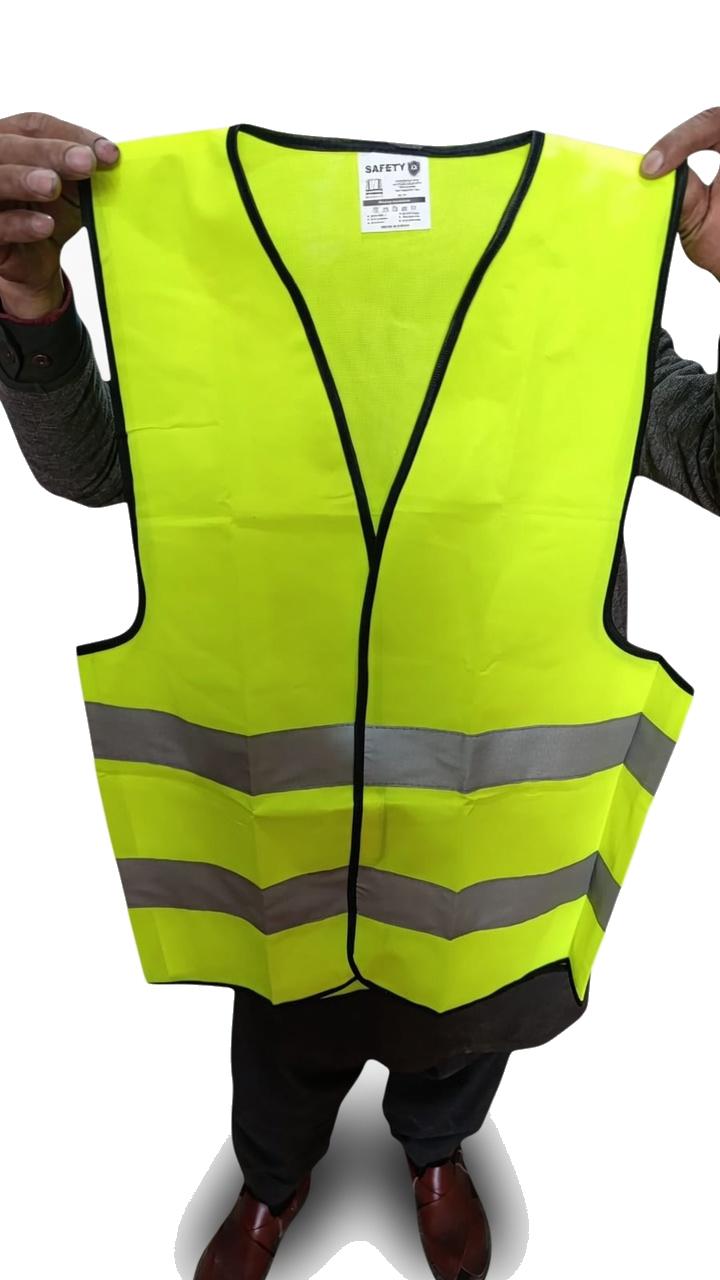
Reflective Safety Jacket
High visibility vests in orange and yellow, plain or printed, supplied by the carton.
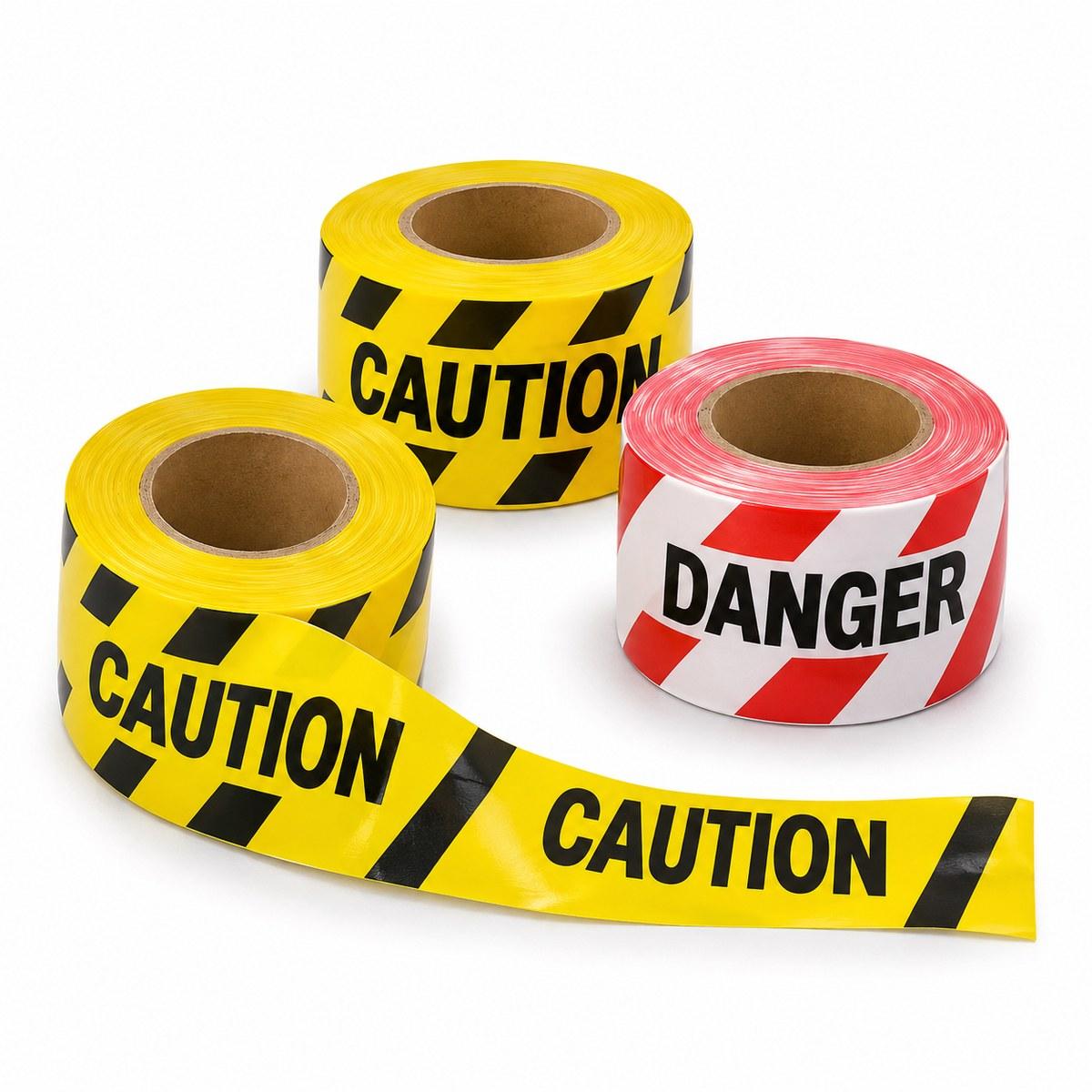
Barricade & Caution Safety Tape
Non-adhesive barricade tape in yellow and black CAUTION and red and white DANGER, for cordoning off excavations, spills and work zones.
FAQ
Questions buyers ask us
What is the price of a traffic cone in Pakistan?
In 2026 a 450 mm PVC cone costs about PKR 600 to 1,200, a 750 mm PVC cone with reflective collars PKR 1,400 to 2,800, a 750 mm cone on a rubber base PKR 2,200 to 4,000 and a 1000 mm cone PKR 3,500 to 6,500. Confirm today's price on WhatsApp, rates move with the exchange rate.
Which traffic cone size is used on highways?
On motorways and national highways crews use 750 mm cones as the minimum and 1000 mm cones where speeds pass about 80 km/h or visibility is poor. The 450 mm cone is for car parks, factory yards and slow urban streets, not for high speed lanes.
Is a rubber base cone better than a PVC cone?
On roads, yes. A rubber base adds weight, usually taking a 750 mm cone to about 3 to 4.5 kg, so the slipstream from a truck does not knock it over. A one piece PVC cone of 1 to 2 kg is fine indoors and in parking areas.
How many traffic cones do I need for a lane closure?
As a planning figure, a single lane closure on a dual carriageway needs about 40 to 80 cones once you count the taper, the length along the work and the exit. The approved traffic management plan sets the real number, so add 10 percent spare for damage.
Why do traffic cones fade?
PVC orange fades under strong UV. In Pakistani sun an unstabilised cone can turn pink within 1 to 2 summers and the reflective collars dull with dust. Buy UV stabilised PVC, wash the collars monthly and retire cones that no longer look bright orange at 100 metres.